


Poverty is not just a statistic; it is a global challenge with ripple effects for billions. Consider this: An increase of 10% in living standards has been associated with a remarkable 31% decrease in poverty levels globally. Most people assume simple economic growth is enough to solve the problem. The truth is, the most effective strategies blend smart government action, business innovation, and new ways to measure what actually works.
Quick Summary
| Takeaway | Explanation |
|---|---|
| Inclusive Economic Growth Models are Essential | Effective poverty reduction requires policies that simultaneously promote economic growth and reduce income inequality, harnessing models that demonstrate a 10% increase in living standards can lead to a 31% drop in poverty levels. |
| Targeted Investments and Social Protection are Critical | Long-term poverty alleviation strategies must include investments in education, healthcare access, microfinance, and technology transfer to create sustainable socioeconomic pathways. |
| Governments Must Adopt Adaptive Policy Frameworks | Successful poverty reduction necessitates strategic government interventions, such as comprehensive social protection systems and adaptive governance, which can respond to global economic changes and sustainably support vulnerable populations. |
| Business Innovations Play a Transformative Role | Companies should leverage inclusive business models and technological advancements to integrate low-income communities into value chains, thereby generating economic opportunities and promoting systemic change. |
| Robust Measurement and Scaling Methods are Key | Developing sophisticated evaluation frameworks with multidimensional metrics and advanced analytical approaches is vital for understanding intervention effectiveness and scaling successful poverty reduction strategies. |
Economic Approaches to Poverty Reduction
Economic strategies represent a critical pathway to addressing global poverty challenges. Understanding the complex mechanisms that drive economic transformation offers powerful insights into sustainable poverty reduction methods. Poverty reduction strategies must go beyond simplistic approaches and embrace sophisticated economic interventions that create lasting systemic change.
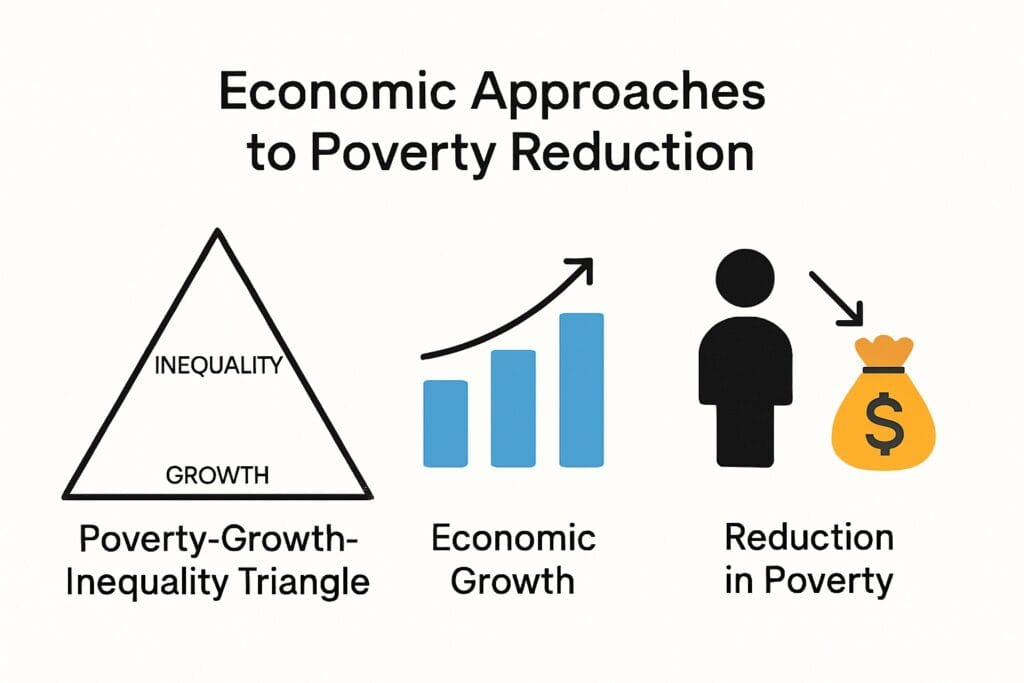
Economic growth serves as a fundamental mechanism for poverty alleviation. Research from the World Bank demonstrates that targeted economic development can dramatically reduce poverty levels. According to groundbreaking studies, a 10% increase in average living standards can potentially reduce poverty by up to 31%. This highlights the profound connection between economic expansion and poverty mitigation.
The Poverty-Growth-Inequality Triangle model provides a comprehensive framework for understanding these dynamics. This economic approach emphasises that effective poverty reduction requires policies that promote economic growth while simultaneously reducing income inequality. By recognising how changes in inequality affect economic growth, policymakers can design more nuanced intervention strategies.
Strategic Investment and Social Protection
Economic approaches to poverty reduction extend beyond simple growth metrics. Long-term strategies must incorporate targeted social protection expenditures and strategic investments in human capital. Comprehensive economic research indicates that social protection becomes increasingly significant in addressing poverty over extended periods.
Key investment areas include:
- Education infrastructure that creates sustainable skill development pathways
- Healthcare access improving workforce productivity
- Microfinance programs enabling entrepreneurial opportunities
- Technology transfer supporting economic modernization
Innovative Economic Policy Frameworks
Successful poverty reduction requires adaptive economic policy frameworks that respond to dynamic global economic conditions. Governments and international organisations must develop flexible strategies that quickly adjust to emerging economic challenges. This requires a multifaceted approach integrating economic planning, social policy, and technological innovation. Economic studies from leading global institutions suggest that comprehensive economic approaches should:
- Promote inclusive economic growth
- Reduce systemic economic barriers
- Create robust social safety networks
- Support small and medium enterprise development
- Encourage skill development and workforce training
By implementing sophisticated, data-driven economic strategies, societies can create powerful mechanisms for sustainable poverty reduction. The future of global economic development lies in understanding these complex interconnections and designing holistic approaches that empower individuals and communities.
Economic transformation is not just about increasing monetary wealth but about creating environments where individuals can access opportunities, develop skills, and participate meaningfully in economic ecosystems. As global economic landscapes continue evolving, innovative and adaptive poverty reduction strategies will become increasingly crucial in addressing systemic economic challenges.

Policy Initiatives and Government Roles
Governments play a pivotal role in designing and implementing comprehensive poverty reduction strategies that address complex socioeconomic challenges. Policy initiatives represent the primary mechanism through which nations can systematically tackle poverty by creating robust frameworks that support vulnerable populations and promote economic opportunities.
Strategic Policy Frameworks and Redistribution
Research from the OECD reveals a compelling statistic about government effectiveness: through targeted redistribution policies involving taxes and transfers, countries can reduce relative poverty rates from 27% to 11%. This dramatic reduction illustrates the vital role of strategic government interventions in mitigating economic disparities.
Effective policy frameworks must incorporate multidimensional approaches that go beyond monetary considerations. These frameworks should focus on:
- Comprehensive social protection systems
- Targeted economic empowerment programs
- Inclusive educational opportunities
- Healthcare accessibility initiatives
To better illustrate the impact of strategic government interventions in poverty reduction, the following table summarises the effects of targeted redistribution policies based on the information provided in this section.
| Policy Approach | Pre-Intervention Poverty Rate | Post-Intervention Poverty Rate | Key Mechanisms |
|---|---|---|---|
| No targeted redistribution | 27% | — | Poverty remains high |
| Taxes and transfers (redistribution) | 27% | 11% | Income redistribution, expanded access |
International Collaboration and Policy Safeguards
The International Monetary Fund’s 2025 guidance introduces strengthened policy safeguards to ensure countries at high debt risk implement robust poverty reduction strategies. These safeguards underscore the importance of sustainable growth policies that balance economic stability with social welfare objectives.
International collaboration becomes crucial in developing adaptive policy mechanisms. Governments must work together to:
- Share best practices
- Develop coordinated economic interventions
- Create transnational support networks
- Implement flexible policy responses to emerging global challenges
Social Protection and Adaptive Governance
The OECD’s 2024 policy dialogue highlighted the critical role of social protection programmes in addressing poverty. These programs go beyond immediate financial support, focusing on improving long-term outcomes in health, education, and nutrition.
Adaptive governance models require governments to:
- Develop data-driven policy interventions
- Create responsive social safety networks
- Invest in technological infrastructure
- Support community-based economic development initiatives
Successful poverty reduction demands a holistic approach that recognises the interconnected nature of economic challenges. Governments need to go beyond old welfare models and use new, flexible methods that give people and communities more power.
The future of poverty reduction lies in creating intelligent, adaptive policy ecosystems that can respond quickly to changing economic landscapes. By combining robust social protection, strategic economic interventions, and collaborative international approaches, governments can develop powerful mechanisms for sustainable poverty alleviation.
Business Innovations Driving Social Impact
Business innovations have emerged as a transformative force in addressing global poverty challenges. By reimagining traditional economic models, companies are developing sophisticated approaches that create sustainable social impact while generating economic value. Poverty reduction strategies increasingly recognise the pivotal role of innovative business models in creating meaningful systemic change.
Inclusive Business Models and Value Chain Integration
Research published in the Journal of Cleaner Production draws attention to the advantages of inclusive business models that strategically integrate low-income communities into economic value chains. These approaches go beyond traditional corporate social responsibility, creating genuine economic opportunities for marginalised populations.
Key characteristics of successful inclusive business models include:
- Direct economic participation for vulnerable communities
- Skill development and capacity-building initiatives
- Fair compensation and sustainable income generation
- Technology transfer and knowledge sharing
Agricultural Innovation and Rural Transformation
The World Bank’s comprehensive research demonstrates that technological innovations in agriculture represent a critical pathway for poverty reduction. By empowering rural communities through advanced farming technologies and management practices, businesses can create substantial economic opportunities. The International Fund for Agricultural Development emphasises the transformative potential of technical innovations, particularly in:
- Crop diversification strategies
- Precision agricultural technologies
- Sustainable farming management systems
- Market access improvement programs
Technology-Driven Social Enterprise Models
Emerging social enterprise models leverage technological innovations to address poverty through scalable and sustainable approaches. These businesses combine entrepreneurial strategies with social impact objectives, creating economic ecosystems that generate value for both investors and communities.
Advanced social enterprise approaches focus on:
- Digital financial inclusion platforms
- Microfinancing technologies
- Skills training through digital infrastructure
- Remote workforce development programs
The following table summarises key innovative business approaches and their principal features, as described throughout this section.
| Business Innovation Approach | Key Features | Target Outcome |
|---|---|---|
| Inclusive Business Models | Direct participation, skills development, fair pay, technology transfer | Economic opportunities for low-income communities |
| Agricultural Innovation | Crop diversification, precision tech, sustainable management, market access | Rural transformation, increased productivity |
| Social Enterprise Models | Digital inclusion, microfinance, digital skills training, remote workforce | Scalable and sustainable poverty reduction |
Successful business innovations driving social impact require a holistic understanding of complex economic ecosystems. Companies must move beyond their traditional profit-driven models and embrace strategies that create genuine value for marginalised communities.
The future of poverty reduction lies in collaborative approaches that recognise the interconnectedness of economic development. By integrating technological innovation, strategic business models, and community-centred design, businesses can become powerful agents of sustainable social transformation.
As global economic landscapes continue evolving, the most effective poverty reduction strategies will emerge from innovative businesses that can simultaneously generate economic value and create meaningful social impact. This represents a fundamental shift from traditional charitable models to sophisticated, sustainable approaches that empower individuals and communities.
Measuring and Scaling Successful Strategies
Measuring and scaling poverty reduction strategies represents a critical challenge in creating sustainable global economic transformation. Effective evaluation frameworks enable policymakers, researchers, and organisations to understand complex intervention outcomes and develop replicable approaches that generate meaningful social impacts.
Comprehensive Evaluation Frameworks
Research from the International Monetary Fund highlights the importance of establishing comprehensive intermediate indicators alongside traditional poverty outcome measures. This sophisticated approach allows for nuanced monitoring and real-time feedback mechanisms that support dynamic strategy refinement.
Key components of robust evaluation frameworks include:
- Multidimensional performance metrics
- Quantitative and qualitative assessment tools
- Longitudinal tracking systems
- Contextual adaptability indicators
Strategic Scaling Methodologies
The Brookings Institution’s development research emphasises that successful scaling requires a clear vision, strategic driver identification, and a continuous progress assessment. Organisations must develop adaptive approaches that can transform locally successful interventions into broader systemic solutions.
Effective scaling strategies demand:
- Comprehensive impact documentation
- Flexible implementation protocols
- Stakeholder engagement mechanisms
- Continuous learning and adaptation processes
Advanced Analytical Approaches
Organisations A groundbreaking study utilising fuzzy cognitive maps demonstrates the potential of advanced analytical techniques for evaluating poverty alleviation strategies. By integrating complex computational models with traditional research methodologies, researchers can develop more detailed knowledge about intervention effectiveness.
Advanced analytical approaches focus on:
- Multi-dimensional performance mapping
- Complex systems modeling
- Predictive intervention assessment
- Dynamic strategy optimization
Successful poverty reduction requires moving beyond simplistic measurement approaches. Organizations must embrace sophisticated, technology-enabled evaluation frameworks that capture the intricate dynamics of economic and social transformation.
The future of poverty measurement lies in creating intelligent, adaptive systems that can rapidly assess intervention effectiveness, identify emerging challenges, and support continuous strategy refinement. By combining rigorous analytical techniques with flexible implementation models, researchers and policymakers can develop more responsive and impactful poverty reduction approaches.
Ultimately, measuring and scaling successful strategies is not just about collecting data but about creating dynamic learning ecosystems that can continuously evolve and improve. This approach transforms poverty reduction from a static intervention to a responsive, adaptive process capable of addressing complex global economic challenges.
Frequently Asked Questions
What are the most effective poverty reduction strategies for 2025?
Effective poverty reduction strategies for 2025 include inclusive economic growth models, strategic investments in education and healthcare, adaptive governance, and business innovations that integrate low-income communities into value chains.
What is the connection between economic growth and lowering poverty?
Studies show that a 10% rise in living standards can lead to a 31% drop in global poverty levels. This shows that economic growth, when combined with policies that reduce inequality, is necessary for effective poverty reduction.
What role do governments play in poverty reduction initiatives?
Governments play a critical role by designing and implementing comprehensive policy frameworks that promote social protection, redistribute resources, and foster adaptive governance mechanisms to respond to economic challenges.
How can businesses contribute to poverty reduction?
Businesses can reduce poverty by adopting inclusive business models, leveraging technology for social impact, and creating economic opportunities for marginalised communities through fair compensation and skill development.