
Online MBA programs deliver graduate business education primarily via digital platforms, preserving the core MBA subjects—strategy, finance, and leadership—while adding flexibility and modular credentials. In 2025, these programmes will undergo a significant transformation: AI-driven personalisation, hybrid residencies, and stackable microcredentials are merging to transform the way individuals acquire managerial skills and how employers validate them. This article gives practical, evidence-backed insight into those trends. You’ll get clear guidance on which technologies matter, how programme formats are adapted for working professionals, which specialisations are rising, what career impacts to expect, and what to watch out for when choosing an online MBA. We’ll review technology and design innovations; compare program structures; profile in-demand fields; summarise benefits and ROI factors; assess global partnerships; and flag accreditation and privacy issues. Expect actionable advice about matching program choices with your career goals and evaluating program credibility in a fast-changing market.
What Are the Top Technological Innovations Shaping Online MBA Programs in 2025?
The most consequential technologies for online MBAs are artificial intelligence for tailored learning, virtual and augmented reality for immersive practice, and learning analytics for data‑driven student support and curriculum improvement. Together, they customise content to meet learners’ needs, recreate hands-on scenarios for skill practice, use outcome data to predict retention, and inform program decisions. AI creates customised learning paths and automates formative feedback. VR/AR creates simulation environments for practicing leadership and negotiation. Analytics finds patterns that help with targeted support and curriculum tuning. These tools provide clear pedagogical benefits, but they also raise questions about data privacy, algorithmic fairness, and equitable access that programmes must address. Understanding how these technologies work clarifies why institutions and employers increasingly value technology-enhanced online MBAs and sets the stage for a closer look at each application.
Key digital learning innovations to watch in 2025 include:
- AI-driven personalisation: engines that sequence content and assessments according to an individual’s performance, improving mastery and engagement.
- VR/AR simulations: Immersive scenarios for practicing negotiation, leadership, and operations in repeatable, low-risk settings.
- Learning analytics: Dashboards and models that identify at‑risk learners, inform curriculum adjustments, and measure skill growth over time.
These technologies reshape instructional design and assessment. The sections below explore AI and VR/AR in greater detail.
How Is AI Enhancing Online MBA Learning Platforms?

AI improves online MBA platforms by creating personalised learning journeys, automating routine assessments, and powering predictive analytics that support retention and programme quality. Personalisation engines analyse interactions to recommend modules, adjust difficulty, and suggest sequences of microcredentials so learners follow an efficient path to competency. Automated grading and feedback tools speed up formative feedback on casework and simulations, freeing instructors to focus on coaching and higher‑order skills. Predictive models flag students who need intervention and inform decisions on pacing, electives, and employer‑aligned capstone projects. These capabilities can boost completion rates and relevance, but programs should deliberately blend automation with human mentorship to preserve leadership development and networking values.
AI Tutors Revolutionise Executive MBA Learning with Personalised Experiences This study examines how AI tutors are reshaping executive MBA delivery by offering customised learning paths for busy professionals. It reviews the executive education landscape, outlines AI tutor features—style analysis, adaptive delivery, and real‑time feedback—and presents case studies showing improved learner engagement and targeted skill development. The paper also discusses implementation challenges such as ethics, data privacy, and balancing human guidance with automated support. Recommendations include transparent communication among institutions, developers, and learners, iterative algorithm refinement, and longitudinal research to measure long‑term career impact. Revolutionising Executive Education: AI Tutors and Tailored MBA Learning Experiences, 2024
What Role Do VR and AR Play in Immersive MBA Learning Experiences?
VR and AR are increasingly being used to create realistic practice environments for managerial behaviours that classroom texts cannot easily teach. Virtual negotiation rooms, simulated board meetings, and augmented operations dashboards let students apply theory under time pressure and receive recorded feedback for reflection. These immersive experiences strengthen behavioural competencies—negotiation, crisis leadership, and cross-cultural communication—by producing high-fidelity scenarios that relate to workplace performance. Adoption barriers include hardware costs, bandwidth, and the need to align scenarios with assessment rubrics. Still, falling technology costs and shared lab models are improving scalability. As VR/AR use grows, programme designers must ensure scenarios tie directly to competency frameworks employers recognise.
| Technology | Primary applications in MBA programmes | Typical Benefit |
|---|---|---|
| Artificial Intelligence | Personalisation, automated feedback, predictive analytics | Higher completion and targeted learner support |
| Virtual/Augmented Reality | Immersive simulations for leadership, negotiation, operations | Better skills transfer and learner engagement |
| Learning Analytics | Curriculum tuning and early‑warning systems | Data-driven programme improvement |
This comparison shows distinct strengths: AI customises learning; VR/AR creates practice spaces; and analytics guides strategy. The next section looks at structural changes that make these technologies practical within flexible MBA formats.
How Are Online MBA Programme Structures Evolving for Greater Flexibility?
Programme structures are shifting toward hybrid residencies, accelerated tracks, and stackable micro‑credentials that let learners combine modular learning into full degrees. Hybrid models pair asynchronous coursework with short on‑campus or virtual residencies to preserve networking and experiential learning while minimising travel. Accelerated formats compress terms into intensive modules for professionals who want faster completion. Stackable credentials let students earn certificates that ladder into an MBA, enabling employer‑aligned upskilling with lower upfront cost. These shifts lower barriers and create modular pathways that fit varied career timelines while keeping core elements—core courses, capstones, and career services—intact. Below we compare common formats to help prospective students weigh trade‑offs.
Common program formats were compared:
- Fully online: Entirely remote delivery with a mix of asynchronous and synchronous elements—best for schedule flexibility.
- Hybrid: Mostly online with short, in‑person residencies for networking and hands‑on learning.
- Stackable credentials: modular certificates that accumulate towards degree credits and employer-recognized certifications.
These formats serve different audiences—busy professionals, executives who prioritise networking, and career changers seeking modular skill builds. The table below highlights practical attributes.
| Programme Format | Time Commitment | Residency Requirement | Credit Stacking |
|---|---|---|---|
| Fully online | Moderate to flexible | None or optional | Often limited, but possible |
| Hybrid | Structured with block periods | Short in‑person residencies | Commonly accepted |
| Accelerated | High intensity, shorter duration | Minimal but concentrated | Usually within the degree plan |
| Stackable credentials | Modular, flexible | Typically none | Designed to stack toward the degree |
Use this comparison to choose a format that fits your schedule and career objectives. The next subsection digs deeper into hybrid models.
What Are Hybrid MBA Models, and How Do They Blend Online and On-Campus Learning?
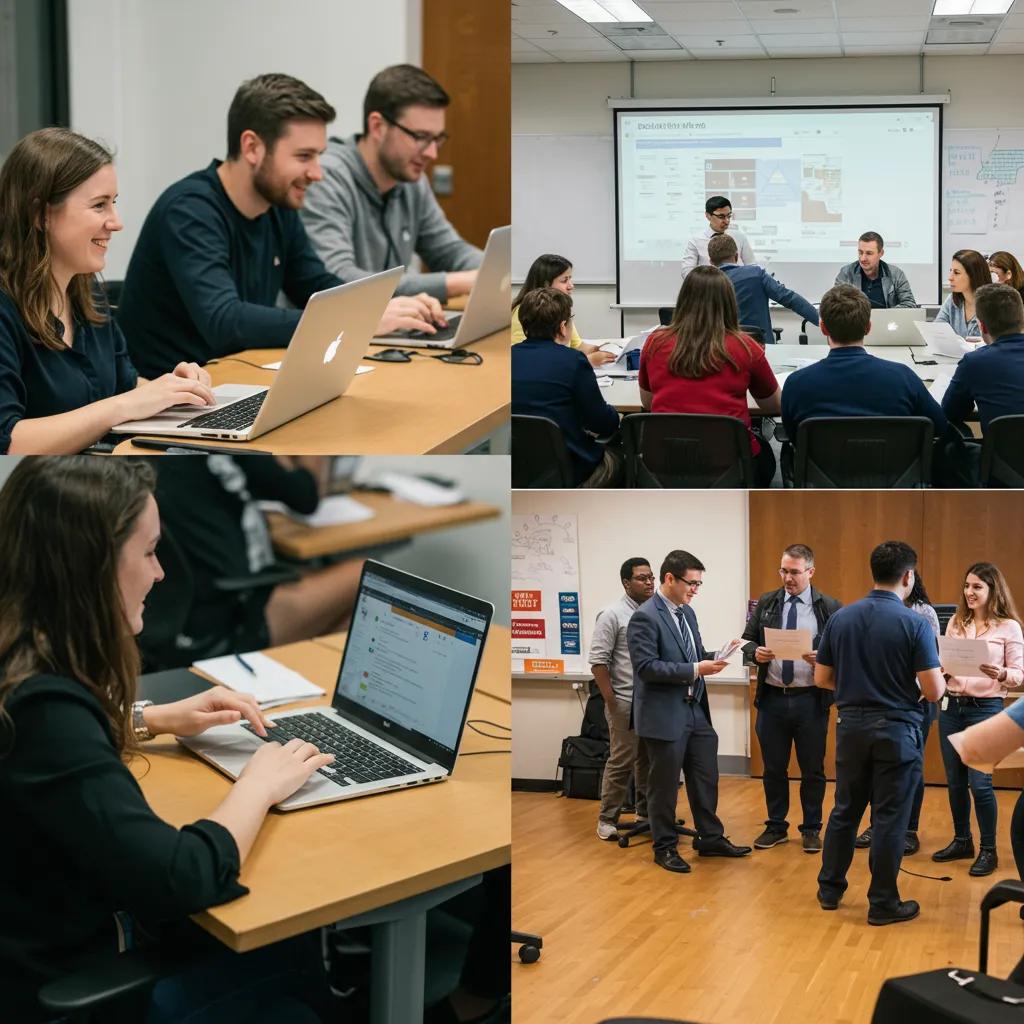
Hybrid MBAs mix online coursework with short, intensive on‑campus residencies or synchronous virtual sessions to marry flexibility with high‑value interpersonal experiences. Core theory and asynchronous modules are delivered online, while residencies focus on simulations, team projects, and alumni networking to build relationships that lead to mentoring and job opportunities. This model preserves essential program components, like capstones and residency modules, without requiring long absences from work. Trade‑offs include travel logistics and periodic scheduling that may need employer support, but hybrids often produce stronger cohort cohesion and richer experiential learning than fully remote alternatives. Understanding these trade‑offs helps candidates secure employer sponsorship or adjust schedules—and naturally connects to the rise of micro‑credentials.
How Are Micro-Credentials and Stackable Degrees Changing MBA Education?
Micro‑credentials and stackable degrees are making MBA education more modular and job‑aligned. Micro‑credentials teach discrete competencies—data analytics, fintech, ESG reporting—that can be earned as certificates or badges and later credited toward an MBA, delivering immediate workplace value plus cumulative academic credit. Employers increasingly accept these stackable certificates, which come from recognised institutions and include verified competency assessments. Important considerations are credit transferability, issuer accreditation, and how stackable credentials integrate with core program elements, like capstones and career services. Programmes that publish clear credit pathways and employer‑aligned outcomes make stacking a practical route to an MBA for mid‑career learners.
Which Specialised Online MBA Fields Are Gaining Popularity in 2025?
The specialisations on the rise include fintech, data analytics, sustainability (ESG), healthcare management, and digital marketing—all driven by employer demand for domain-specific managerial skills. This concentration pairs technical knowledge with leadership and strategy so graduates can move into management roles within specialised industries. Employers favour specialisations that combine technical depth with business acumen—for example, data analytics plus finance for fintech roles, or sustainability frameworks integrated with corporate strategy for ESG leadership. Choose fields that match market demand and your career plan, and make sure coursework aligns with target job titles and employer expectations.
Specialisations map to different skills and employment pathways.
| Specialisation | Core Skills Taught | Typical Job Titles / Employers |
|---|---|---|
| Fintech MBA | Digital finance, blockchain fundamentals, regulatory frameworks | Fintech startups, banks, payment platforms |
| Data Analytics MBA | Statistical modelling, BI tools, data strategy | Analytics leads, product managers, consulting firms |
| Sustainability (ESG) MBA | ESG frameworks, impact measurement, CSR strategy | Corporations, NGOs, sustainability consultancies |
| Healthcare Management MBA | Health systems strategy, policy, operations | Hospitals, payers, healthtech startups |
Use this map to match specialisation choices with industry needs and likely employers. Next, we offer practical steps to tailor an MBA to your target role.
What Are the Most In-Demand Online MBA Specialisations for Future Careers?
The most in‑demand MBA tracks combine domain expertise with managerial skills: data analytics and fintech for finance and tech roles, sustainability for ESG leadership, healthcare management for clinical‑administrative careers, and digital marketing for product and growth functions. Drivers include digital transformation, regulatory change, and corporate sustainability priorities that require leaders who understand both technical details and strategic trade‑offs. Employers prefer candidates who can lead cross-functional teams and turn analytics into actionable strategies, so programs that integrate applied projects and employer partnerships have an advantage. When choosing a speciality, prioritise programs with practical capstones, industry projects, or internships that deliver tangible outcomes.
How Can You Tailor Your Online MBA to Align with Industry Needs?
Tailor your online MBA by choosing electives, micro‑credentials, capstone projects, and employer partnerships that map directly to your target job roles. Start by listing desired job titles and the essential competencies they require—technical tools, methods, and domain knowledge—then pick courses and certificates that close those gaps. Use capstones to solve real employer problems and earn micro‑credentials that validate tool proficiency. Leverage career services and alumni networks to secure mentorship and project placements. These steps turn program learning into measurable, employer-relevant results and improve ROI.

What Are the Key Benefits and Career Impacts of Future Online MBA programs?
Future online MBAs deliver several clear benefits: flexible formats that let students keep working, broader access across geographies, and focused specialisations that boost career mobility. Flexibility enables professionals to upskill without pausing their careers; asynchronous modules reduce relocation and time‑away costs. Career outcomes often include faster promotion paths, larger managerial scope, and improved ability to move into growing fields—especially when programmes couple specialisation with applied capstones. As an information hub, Logical Content provides balanced analysis to help prospective students weigh career impacts and ROI by examining programme design, employer partnerships, and graduate outcomes. Evaluate program outcomes against your goals to estimate the likelihood of career uplift.
Benefits summarised:
- Flexibility: Modular scheduling and asynchronous modules let learners balance work, family, and study.
- Accessibility: Online delivery removes geographic barriers and widens access to quality programming.
- Career mobility: Targeted specialisations and capstones create clearer pathways for promotion or role changes.
These benefits translate to career outcomes when programs combine high-quality instruction with employer projects and verified competencies. The following section looks at flexibility and accessibility in practice.
How Do Online MBAs Offer Flexibility and Accessibility for Working Professionals?
Online MBAs provide flexibility through asynchronous design, modular scheduling, and concentrated residencies that reduce extended time away from work. Live seminars and peer workshops are scheduled to preserve cohort interaction while most learning remains asynchronous. Geographic accessibility attracts international learners, increasing cohort diversity and employer networks. Micro‑credentials let learners upskill incrementally without committing to full‑time study. Time management and institutional supports—tutoring, structured milestones, and employer sponsorship—are crucial to success, so evaluate those supports before enrolling. These considerations set up a realistic assessment of career advancement and salary impact.
What Career Advancement and Salary Benefits Can Online MBA Graduates Expect?
Graduates of an online MBA typically see improved promotion prospects, stronger candidacy for managerial roles, and potential salary gains—especially when programs include employer partnerships, applied capstones, and recognised accreditation. Salary outcomes depend on specialisation, prior experience, local labour markets, and institutional reputations; technical tracks often command premiums in tech and finance. Long‑term gains hinge on alignment between coursework and employer needs, alumni network strength, and applied project experience that demonstrates impact. Review program employment reports and alumni trajectories to establish realistic ROI expectations and timelines.
How Are Global Partnerships and Diverse Perspectives Influencing Online MBA Trends?
Global partnerships and diverse cohorts are shaping online MBAs by bringing cross‑cultural perspectives into curricula and widening employer exposure through institutional collaboration. Collaborations across regions enable co‑created modules, joint residencies, and multinational capstones that simulate global strategic challenges. Diverse cohorts expose students to different business norms and markets, strengthening intercultural leadership skills valued by international employers. Accreditation and credential recognition across jurisdictions can complicate partnerships, but clear agreements preserve credit portability and mutual recognition. These trends encourage programs to design global experiences that map to employer needs and students’ career goals.
What Role Do International Partnerships Play in Online MBA programs?
International partnerships enable shared curriculum design, faculty exchanges, and joint modules that inject region‑specific expertise into online MBAs. They support joint residencies, exchange options, and shared capstones that expose students to different regulatory and market environments—valuable experience for global leadership roles. For learners, partnerships expand access to international alumni networks and corporate partners that can provide internships or hiring pipelines. Operationally, institutions must clarify credit recognition and accreditation alignment so stacking credentials and completing degrees are straightforward for students.
How Can Online MBAs Help Build a Global Professional Network?
Online MBAs build global networks through cohort-based learning, virtual events, mentorship programmes, and alumni platforms designed to sustain professional relationships. Repeated team projects and cohort assessments create collaboration patterns, while virtual events and speaker series increase employer exposure. Residencies—virtual or in‑person—accelerate relationship‑building through face‑to‑face time and deeper mentoring. To get the most from networking, engage proactively in mentorships, alumni activities, and employer projects that convert short‑term contacts into long‑term career resources. These networking mechanisms lead naturally to the final topic: evaluating program quality and trade-offs.
What Challenges Should Prospective Students Consider Regarding Online MBA Programs?
When evaluating online MBAs, consider networking limits, variable programme quality, accreditation differences, and technology and privacy risks. Online formats can limit spontaneous networking unless programs design intentional cohort experiences and residencies. Self‑directed learning demands solid time management. Quality varies widely, so look for recognised accreditation, transparent employment outcomes, and employer partnerships as vetting criteria. Technology raises data privacy and algorithmic bias concerns—especially where AI customises assessments—so ask about data governance and fairness safeguards. Knowing these challenges helps you choose programs that minimise risk while delivering real career value.
Common challenges to weigh:
- Networking depth: Building long‑term, high‑value relationships is harder without strong residencies and mentorship.
- Self‑directed learning demands success, discipline, time management, and reliable institutional support.
- Accreditation and quality variance: programs differ in rigour—thorough vetting is essential.
The next subsection outlines mitigation tactics and ways to verify program quality.
What Are the Common Challenges in Online MBA Learning and Networking?
Common issues include social isolation, uneven engagement, and fewer organic networking moments than on campus. Programs can counter these with structured synchronous activities, formal mentorships, intensive residencies, and team-based capstones tied to employer projects. Time management is a frequent obstacle for working learners, so supports like clear deadlines, coaching, and flexible scheduling improve completion rates. Access to experiential learning—simulations, internships, or employer projects—varies, so prioritise programs that explicitly include applied experiences and strong employer engagement.
How Is Quality and Accreditation Ensured in Online MBA Programs?
Quality and accreditation are demonstrated through recognized accrediting bodies and transparent outcome reporting. Look for alignment with AACSB, AMBA, or EQUIS and for published employment outcomes, faculty credentials, and employer partnerships. Strong indicators include active faculty involvement, verifiable placement statistics, capstones linked to industry problems, and clear credit transfer pathways for stackable credentials. Red flags include opaque outcomes, unverifiable employer claims, and minimal faculty participation. Ask programmes for published outcome reports and clear policies on how micro‑credentials and stacked credits convert into the full degree to avoid surprises.
Logical Content’s role is to synthesise research, program models, and market signals so readers can evaluate quality indicators and trade‑offs between cost, flexibility, and career impact. Our goal is to keep you informed and confident as online MBA programmes evolve.
Frequently Asked Questions
What are the main differences between fully online and hybrid MBA programs?
Fully online MBAs run entirely remotely with a mix of asynchronous and live sessions, offering the most schedule flexibility. Hybrid MBAs pair online coursework with short, intensive in‑person residencies to add face‑to‑face networking and experiential learning. Choose based on whether you prioritise flexibility or in-person relationship building—and consider employer support for residencies if needed.
How do stackable microcredits work in online MBA programs?
Stackable micro‑credentials are short, focused courses that award certificates or badges for specific skills. Those credits can later be applied toward an MBA at participating institutions, giving learners immediate workforce value while building toward a full degree. Confirm transfer rules and accreditation before relying on stacking as a path to a degree.
What do students look for in terms of program accreditation?
Prioritise programmes accredited by recognised bodies such as AACSB, AMBA, or EQUIS. Accreditation signals adherence to academic standards. Also review published employment outcomes, faculty qualifications, and employer partnerships. Transparent data and verified claims are strong indicators of the program’s credibility.
How do online MBA programs enhance networking opportunities?
Programmes can boost networking with cohort models, structured virtual events, mentorship programmes, and residencies that enable face‑to‑face connection. Active participation in alumni groups and employer projects turns short‑term contacts into lasting relationships—so engage proactively and use career services to find mentorship and project opportunities.
What are the potential career impacts of completing an online MBA?
An online MBA can accelerate promotions, expand managerial responsibilities, and increase earning potential—especially when paired with employer partnerships, capstones, and recognised accreditation. Outcomes vary by speciality, experience, and institutional reputation, so review alumni data to form realistic expectations about ROI and timelines.
What challenges do online MBA students face in terms of engagement?
Students face isolation, uneven engagement, and fewer spontaneous networking opportunities compared with campus programs. Look for programs that include synchronous cohort activities, mentorship, and application experiences to maintain engagement. Develop strong time management habits to succeed in self‑directed learning environments.
How do technological innovations impact learning in online MBA programs?
Technologies like AI personalisation and VR/AR simulations make learning more adaptive and immersive. AI tailors content and feedback, while VR/AR recreates complex scenarios for practice. These tools can improve engagement and readiness for real‑world challenges, provided programmes use them thoughtfully and responsibly.
Conclusion
Online MBA programmes are adapting to modern learners by offering greater flexibility, broader access, and targeted specialisations that support career mobility. Technology—AI for personalisation and VR for immersive practice—can enhance learning when paired with a solid program design and employer engagement. Prospective students should compare quality markers, published outcomes, and credential transparency to choose programmes that align with their career goals. Use our resources to identify programs that fit your needs and help you advance confidently.