


International trade barriers are shifting the rules for businesses in 2025, making it harder and riskier to connect with overseas markets. Here is the wild part. The World Trade Organization forecasts a 0.2 percent drop in world trade volume this year, with North American exports set to fall by 12.6 percent. Have you considered that trade obstacles might involve more than just additional paperwork? Think again. These evolving barriers are now strong enough to disrupt global supply chains and shrink national economies, forcing companies and countries to change course faster than ever.
Quick Summary
| Takeaway | Explanation |
| Understanding Types of Trade Barriers | Identifying the three main types—tariff barriers, non-tariff barriers, and quota systems—helps businesses anticipate challenges and navigate international trade effectively. |
| Economic Impact of Trade Barriers | Trade barriers disrupt global GDP growth and supply chains, highlighting the need for businesses to adapt to shifting economic conditions and market access challenges. |
| Importance of Regulatory Harmonization | Collaborating on technical standards and creating mutual recognition agreements can significantly lower compliance costs and streamline international trade processes. |
| Need for Strengthened Intellectual Property Rights | Robust IPR protections foster innovation and fair competition, making it crucial for businesses to advocate for consistent legal frameworks across jurisdictions. |
| Focus on Capacity Building for Emerging Economies | Providing targeted support, such as training and infrastructure development, helps developing countries engage more effectively in global trade, creating more inclusive trade environments. |
Types of International Trade Barriers Explained
International trade barriers represent complex mechanisms governments use to control and regulate cross-border economic exchanges. These barriers create significant challenges for businesses seeking global market expansion, impacting everything from small enterprises to multinational corporations.
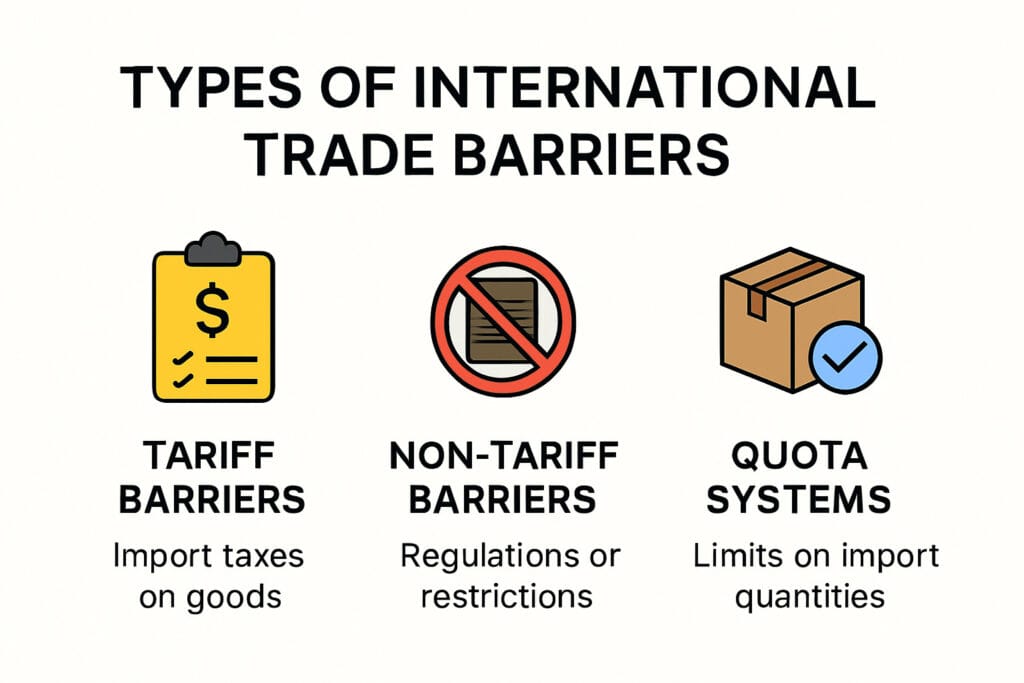
Tariff Barriers: Economic Gatekeepers
Tariffs function as direct financial obstacles in international trade. According to OpenStax, tariffs are taxes imposed on imported goods, effectively increasing their price and reducing their competitiveness compared to domestic products. These financial charges serve multiple strategic purposes:
- Economic Protection: Governments use tariffs to shield domestic industries from foreign competition
- Revenue Generation: Tariffs provide significant income for national treasuries
- Strategic Economic Control: They can influence trade relationships and economic dynamics
Tariff rates vary widely, ranging from minimal percentages to substantial amounts that can effectively prohibit certain imports. Some countries apply complex tariff structures with different rates based on product categories, origin, and existing trade agreements.
Non-Tariff Barriers: Complex Regulatory Mechanisms
Wikipedia defines non-tariff barriers (NTBs) as sophisticated regulatory mechanisms beyond traditional financial taxation. These barriers include:
- Import Licensing: Requiring specific permissions for goods entry
- Technical Standards: Establishing complex product quality and safety requirements
- Rules of Origin: Mandating precise documentation about product manufacturing origins
These regulatory mechanisms create substantial compliance challenges. Companies must invest significant resources in understanding and meeting diverse international regulatory environments. Non-tariff barriers often prove more complex and challenging to navigate than straightforward tariff structures.
Quota Systems: Quantitative Trade Restrictions
Import quotas represent another critical international trade barrier. These systems establish strict numerical limits on specific goods’ import quantities during designated times. Quota mechanisms accomplish several strategic objectives:
- Protecting domestic production capabilities
- Controlling foreign market penetration
- Managing national economic balance
Quotas can dramatically impact global trade dynamics, creating artificial scarcity and potentially increasing domestic product prices. They represent a powerful tool for governments seeking to manage economic interactions and protect local industries.
Understanding these international trade barriers requires recognising their multifaceted nature. They are not mere obstacles but sophisticated policy instruments designed to balance economic interests, protect national industries, and manage complex global economic interactions. Businesses and policymakers must develop nuanced strategies to successfully navigate these intricate regulatory landscapes.

The evolving global economic environment continually reshapes these trade barrier mechanisms, making ongoing research and adaptive strategies essential for international business success.
To help clarify the different mechanisms, the following table compares the main types of international trade barriers discussed above, their definitions, and key features:
| Trade Barrier Type | Definition | Key Features |
| Tariff Barriers | Taxes imposed on imported goods, raising their price compared to domestic products | These measures serve three main purposes: economic protection, revenue generation, and strategic economic control. |
| Non-Tariff Barriers | Sophisticated regulatory mechanisms (not direct taxes), such as licences, standards, and origin rules | Examples of non-tariff barriers include import licensing, technical standards, and rules of origin. |
| Quota Systems | Numerical limits on the quantity of specific goods that can be imported during a set period | It controls foreign penetration, protects domestic industries, and manages the balance of trade. |
Impact of Trade Barriers on Global Markets
International trade barriers significantly reshape global economic landscapes, creating complex ripple effects that extend far beyond immediate national boundaries. These mechanisms fundamentally alter market dynamics, influencing everything from corporate strategies to consumer experiences worldwide.
Economic Growth Disruption
According to the OECD, global GDP growth is projected to slow from 3.3% in 2024 to 2.9% in 2025 and 2026, directly attributable to substantial trade barriers and heightened policy uncertainty. This reduction represents a significant economic challenge, demonstrating how trade restrictions can materially impact global economic performance.
The interconnected nature of modern economies means that trade barriers create systemic vulnerabilities. When one country implements restrictive policies, the consequences quickly propagate through global supply chains, affecting industries and markets far beyond the initial point of intervention.
Supply Chain Reconfiguration
The United Nations forecasts a reduction in global GDP growth to 2.4% in 2025, emphasising how trade tensions fundamentally restructure international commercial relationships. These barriers compel companies to develop more resilient and diversified supply chain strategies.
Key adaptations include:
- Geographic Diversification: Businesses seek alternative manufacturing and sourcing locations
- Local Production Investments: Increased focus on developing domestic manufacturing capabilities
- Strategic Partnerships: Forming alliances to mitigate trade restriction impacts
Trade Volume Contraction
The World Trade Organization anticipates a 0.2% decline in global merchandise trade in 2025, with North American exports expected to drop by 12.6%. This projection underscores the profound economic disruption caused by trade barriers.
The contraction affects multiple economic dimensions:
- Reduced international market access
- Increased production costs
- Diminished economic opportunities for businesses
- Potential inflationary pressures on consumer goods
These trade barriers function as complex economic instruments, simultaneously protecting domestic industries while creating significant systemic challenges. These trade barriers represent a delicate balance between national economic interests and global market integration.
Businesses and policymakers must develop sophisticated, adaptive strategies to navigate these increasingly complex international trade environments. Success will require unprecedented levels of strategic flexibility, technological innovation, and cross-border collaboration.
The following table summarises key global economic projections and data impacted by international trade barriers, as discussed in this section:
| Indicator | 2024 Value | 2025 Projection | Source |
| Global GDP Growth | 3.3% | 2.9% (OECD), 2.4% (UN) | OECD, UN |
| World Trade Volume | – | -0.2% | WTO |
| North American Export Decline | – | -12.6% | WTO |
Recent Policy Changes and Trade Agreements
The global trade landscape continues to evolve rapidly, with significant policy shifts and strategic trade agreements reshaping international economic interactions. These developments reflect complex geopolitical dynamics and emerging economic priorities.
Expanding Trade Blocs and Strategic Partnerships
The Regional Comprehensive Economic Partnership (RCEP) represents a landmark development in international trade cooperation. Encompassing 15 Asia-Pacific countries, this agreement accounts for approximately 30% of the world’s population and global GDP, making it the largest trade bloc in history.
Another notable expansion occurred when the United Kingdom became the first non-original European member to join the Comprehensive and Progressive Agreement for Trans-Pacific Partnership (CPTPP) on December 15, 2024. This move signals a significant strategic realignment in global trade networks, demonstrating the increasing fluidity of international economic partnerships.
Policy Uncertainty and Trade Tensions
The International Monetary Fund (IMF) has highlighted growing concerns about escalating trade uncertainty. Recent tariff announcements have created a complex diplomatic and economic environment, challenging established international trade norms.
Key implications of these policy shifts include:
- Increased Diplomatic Complexity: Negotiating new trade relationships becomes more nuanced
- Economic Recalibration: Countries reassess their global economic strategies
- Supply Chain Restructuring: Businesses adapt to changing regulatory landscapes
Emerging Multilateral Cooperation Strategies
Governments are increasingly acknowledging the need for collaborative approaches to address global trade challenges. This shift reflects an understanding that unilateral actions can produce counterproductive economic consequences.
Emerging cooperation strategies focus on:
- Developing more flexible trade frameworks
- Creating mechanisms for dispute resolution
- Establishing shared economic standards
- Promoting transparent international trade practices
These developments underscore the dynamic nature of global trade. The ability to adapt quickly to changing policy environments has become a critical competitive advantage for nations and businesses alike.
As international trade continues to evolve, stakeholders must remain agile, anticipating potential policy shifts and developing robust strategies to navigate increasingly complex global economic landscapes. The future of international trade will likely be characterised by greater flexibility, strategic partnerships, and innovative approaches to cross-border economic interactions.
Strategies to Overcome International Trade Barriers
Navigating international trade barriers requires sophisticated, multifaceted approaches that address complex economic and regulatory challenges. Businesses and governments must develop innovative strategies to effectively mitigate trade restrictions and create more open, collaborative global markets.
Regulatory Harmonization and Standardization
According to research from the Themba Institute, harmonising technical standards and regulations across countries represents a critical strategy for reducing trade barriers. This approach simplifies market entry for exporters, significantly lowering compliance costs and facilitating smoother trade in goods and services.
Key elements of regulatory harmonisation include:
- Mutual Recognition Agreements: Establishing frameworks that acknowledge different countries’ regulatory standards
- Standardized Certification Processes: Creating uniform documentation requirements
- Collaborative Technical Working Groups: Developing shared understanding of regulatory frameworks
By creating more consistent global standards, countries can dramatically reduce bureaucratic obstacles that impede international trade. These efforts require sustained diplomatic engagement and a commitment to transparent, collaborative policymaking.
Intellectual Property Rights Protection
The Themba Institute highlights that strengthening intellectual property rights (IPR) protection plays a crucial role in overcoming trade barriers. Robust IPR frameworks encourage innovation, facilitate technology transfer, and support fair competition across international markets.
Strategic IPR approaches include:
- International Patent Cooperation: Developing streamlined registration processes
- Cross-Border Enforcement Mechanisms: Creating consistent legal frameworks for protecting innovations
- Technology Transfer Incentives: Designing policies that promote knowledge sharing
These strategies help create more transparent, predictable environments for businesses operating across different national jurisdictions.
Capacity Building and Technical Assistance
Research indicates that providing targeted capacity-building support and technical assistance to developing countries is essential for overcoming trade-related challenges. This approach enables more effective global economic participation and integration.
Comprehensive capacity-building strategies involve:
- Training Programs: Developing skills in international trade regulations
- Infrastructure Development: Supporting technological and logistical capabilities
- Financial Support: Providing resources for regulatory compliance and market entry
By addressing structural economic disparities, these initiatives create more inclusive global trade environments. They recognise that sustainable trade expansion requires comprehensive support from emerging economic actors.
Successfully navigating international trade barriers demands continuous adaptation, strategic thinking, and collaborative approaches. Businesses and governments must remain flexible, leveraging technological innovations and diplomatic strategies to create more open, interconnected global economic systems.
The future of international trade will be defined by those who can most effectively balance national interests with global economic opportunities, transforming barriers into bridges of economic cooperation.
Frequently Asked Questions
What are the main types of international trade barriers?
International trade barriers primarily include three types: tariff barriers, which are taxes on imported goods; non-tariff barriers, which involve complex regulations beyond financial taxes; and quota systems, which set numerical limits on the quantity of specific goods that can be imported.
How do trade barriers impact global markets?
Trade barriers disrupt global GDP growth, reshape supply chains, and decrease trade volume. They create systemic vulnerabilities that can lead to reduced international market access and increased production costs.
What recent policy changes have influenced international trade?
Recent policy changes include the expansion of trade blocs like the Regional Comprehensive Economic Partnership (RCEP) and the UK’s accession to the Comprehensive and Progressive Agreement for Trans-Pacific Partnership (CPTPP), as well as escalating trade tensions and tariff changes that have increased policy uncertainty.
What strategies can businesses implement to overcome trade barriers?
Businesses can implement several strategies to overcome trade barriers, including regulatory harmonisation and standardisation of practices, strengthening intellectual property rights protection, and providing capacity- building and technical assistance, particularly in developing countries.