

AI is evolving project management software from mere task automation to strategic decision-making support, empowering teams to plan, predict, and communicate with enhanced accuracy. This article delves into how cutting-edge AI capabilities—like predictive analytics, generative planning, resource optimisation, and NLP-based reporting—are reshaping workflows and creating measurable outcomes for delivery teams. Readers will learn about the specific ways these improvements are happening, real examples in both Agile and traditional methods, important ethical issues, and how to evaluate AI-powered project management tools in 2025. The article answers six important questions: how AI is changing areas beyond just automation, the use of predictive analytics and risk management, the changing roles and skills of project managers, the best types of tools and how to evaluate them, practical ethics and ways to reduce risks, and new trends like generative planning. Throughout, we provide guidance for aligning technology with team needs and include concise, factual references to Logical Content’s role as an information hub, helping readers navigate vendor claims and industry shifts without endorsing specific products.
How Is AI Transforming Project Management Beyond Basic Task Automation?
AI in project management has moved past just doing simple tasks to include more complex functions that greatly affect planning, predicting outcomes, and communicating with stakeholders. At the fundamental level, predictive models analyse historical delivery data to identify risks sooner, whereas generative models create draft plans and status narratives that minimise administrative burdens and speed up decision-making cycles. The ultimate advantage is smarter workflows: fewer surprises, quicker alignment across teams, and more time for strategic judgement. Grasping these transformations clarifies where teams should invest in tools and governance as AI transitions from helper scripts to the project brain.
AI transformation manifests in four practical areas that teams can directly relate to their challenges:
- Predictive analytics anticipates schedule and budget deviations before they occur.
- Resource optimisation engines automatically balance skills, capacities, and deadlines.
- Generative planning and reporting tools create initial drafts of plans, sprint backlogs, and stakeholder updates.
- Communication automation (NLP summaries and action extraction) that keeps asynchronous teams in sync.
These transformative areas alleviate administrative burdens while surfacing decision-grade signals, and the next section dives into the core automation features that drive them.
Logical Content, as a trusted information hub focused on credible analysis across tech and business topics, synthesises vendor claims, highlights independent testing, and tracks market trends, enabling readers to interpret tool capabilities in context. This positioning helps translate product feature lists into practical evaluation questions for teams selecting AI-enabled PM software.
What Are the Key AI Automation Features in Project Management Tools?
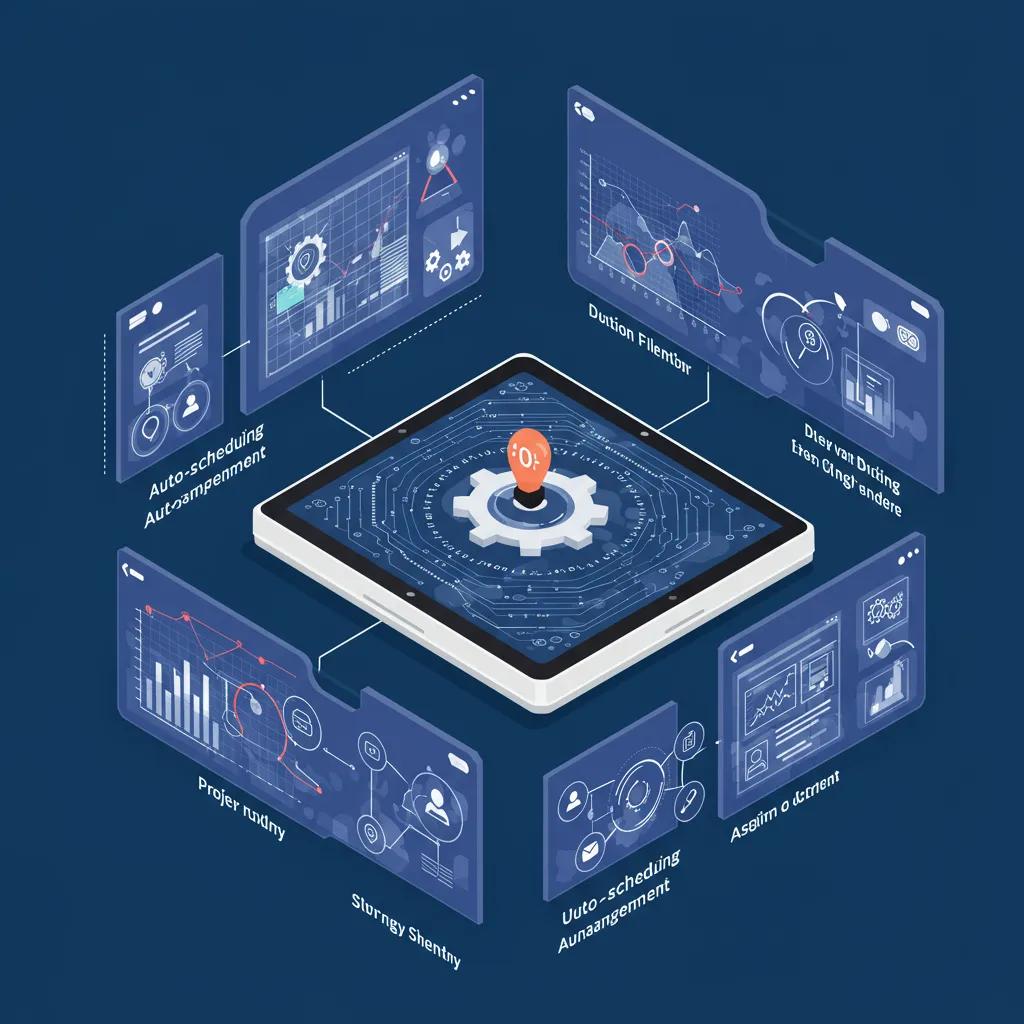
AI automation features now merge traditional rule-based automations with machine learning-driven suggestions, creating a hybrid that both executes and reasons. Core features include:
- Auto-scheduling: Systems deduce realistic task durations from past performance and propose adjusted timelines.
- Intelligent assignment: Skills, availability, and workload data feed recommendation engines for fairer, faster assignments.
- Automated status updates: Activity telemetry transforms into digestible progress notes for stakeholders.
- NLP summaries: Natural language processing synthesises meeting notes and chat into actionable items and decisions.
These features depend on data quality and transparency; teams must ensure input signals (timestamps, completion metrics, skills taxonomy) are consistent to make the automation reliable. The following subsection explores how these technical features alter workflow sequencing and team communication.
How Does AI Improve Workflow optimisation and Communication?
AI enhances workflows by identifying bottlenecks, reprioritizing backlogs based on risk, and minimising latency in handoffs, all of which shorten cycle times and boost predictability. AI uses methods like spotting problems that cause delays, automatically changing priorities when tasks depend on each other, and notifying the right person with just enough information. For communication, AI extracts decisions and action items from discussions and generates clear status narratives tailored to audiences, reducing meeting overhead.
- Bottleneck detection identifies slow workstreams and suggests reallocation.
- Auto-prioritisation adjusts the task order to optimise value delivery under new constraints.
- Context-aware notifications reduce noise by presenting only relevant items to each recipient.
By improving the connection between what teams are doing and their plans, teams can move from just putting out fires to managing their work more effectively, which prepares them for the predictive analytics that will be discussed next.
How Does Predictive Analytics Enhance Project Success and Risk Management?
Predictive analytics leverages statistical models and machine learning to analyse project telemetry and forecast outcomes like delivery dates, budget variances, and risk likelihoods. These models integrate historical performance data, task-level metrics, and external signals to calculate risk scores and expected completion windows, enabling earlier interventions and scenario planning. The immediate benefit is reduced uncertainty: teams gain lead time to reassign resources, rescope work, or escalate issues strategically.
The next subsections clarify how forecasting operates and how allocation benefits from predictive inputs.
How Does AI Forecast Risks and Detect Issues Early?
AI forecasts risk by examining patterns in historical completion times, resource utilisation, and anomalous signals, such as rising reopening rates or declining throughput. Common techniques include time-series forecasting for schedule projection and classification models that predict risk categories based on past failure modes. Alerts are typically surfaced with explainability metadata—key contributing factors and confidence—so project leads can triage effectively. For instance, detecting an unexpected increase in review cycle time might trigger an automatic investigation workflow that reallocates reviewers, preventing schedule slippage.
- Time-series models forecast likely completion windows using past velocities.
- Classification models score the probability of scope creep or cost overrun.
- Anomaly detection highlights outlier behaviours that warrant human review.
Pairing model outputs with human-in-the-loop review ensures that automated signals lead to thoughtful interventions rather than opaque, overconfident escalations.
Before demonstrating how predictive signals drive allocation, the following subsection illustrates practical reallocation mechanisms.
In What Ways Does AI optimise Resource Allocation and Scheduling?

AI-driven allocation balances capacity, skill sets, and deadlines by employing optimisation algorithms that consider constraints and objectives simultaneously. Techniques include constraint programming for hard requirements and heuristic/metaheuristic algorithms for multi-objective trade-offs, like minimising lateness while maximising skill fit. These engines can recommend dynamic reassignments when priorities shift, reducing idle time and costly context switches. A typical outcome is higher utilisation and fewer missed milestones because decisions incorporate both immediate capacity and near-term forecasts.
- Skills-based matching pairs tasks with team members who possess the required competencies.
- Dynamic levelling shifts assignments to prevent overallocation when the forecasted load increases.
- Scenario simulation enables planners to compare what-if outcomes for reallocation options.
The EAV-style table below summarises predictive components and the benefits they provide in resource and schedule contexts.
Predictive analytics components and their outcomes:
| Predictive Feature | Input Data | Outcome / Benefit |
|---|---|---|
| Time-series forecasting | Historical cycle times, velocities | More accurate delivery windows and earlier contingency planning |
| Anomaly detection | Task reopen rates, task age, dependency delays | Early identification of stalled work and targeted triage actions |
| Risk scoring models | Budget burn rates, change frequency, resource churn | Prioritized issue lists and quantified escalation triggers |
This map assists teams in determining which predictive capabilities they should prioritise based on the concrete outcomes they require.
What Is the Evolving Role of Project Managers in the Age of AI?
Project managers are transitioning from mere task supervision to orchestration, ethical oversight, and the strategic utilisation of AI-generated signals. The role now emphasizes interpreting model outputs, establishing governance boundaries, and maintaining stakeholder trust while leveraging automation to eliminate low-value administrative tasks. Consequently, PMs need a hybrid skill set that combines domain expertise with data literacy and vendor evaluation capabilities. The next subsections outline collaborative patterns and the specific skills that are most critical.
Logical Content’s exploration of skills and trends contextualises these role changes by synthesising practitioner interviews and market analyses to highlight which competencies enable effective human-AI collaboration. This coverage provides a prioritised list of upskilling steps PMs can follow when adopting AI-capable tools.
How Do Project Managers Collaborate Effectively with AI Systems?
Effective collaboration models treat AI as an assistant that proposes options rather than a final decision-maker, maintaining human-in-the-loop checkpoints at critical junctures such as scope changes, contract terms, and risk escalation. Practical templates include review-and-approve gates where AI provides candidate plans and humans validate feasibility and retrospective feedback loops where PMs refine model outputs to enhance future predictions. Clear ownership of decisions and documented override procedures prevent automation complacency.
- The AI-as-assistant model supplies ranked options while PMs select and justify final choices.
- Review gates require human sign-off on high-impact changes suggested by AI.
- Continuous feedback refines models by incorporating post-mortem corrections.
These collaboration patterns uphold accountability while unlocking efficiency gains from automation, leading into the skills needed to thrive in this hybrid environment.
What Skills Are Essential for AI-Powered Project Management?
Project managers should focus on a compact set of skills that enable them to interpret AI signals, govern systems, and drive organisational change. Key skills include data literacy for understanding model outputs, ethical judgement to assess bias and privacy impacts, vendor evaluation to compare tool claims, and change management to drive adoption. Practical first steps involve short courses on data fundamentals, hands-on sessions with sandboxed tool outputs, and governance playbook creation.
- Data literacy: Grasp model metrics, confidence, and limitations.
- Ethical oversight: Identify potential bias and privacy exposures in datasets.
- Vendor evaluation: Compare capabilities, integrations, and explainability features.
- Change management: Develop adoption plans and training for teams.
- Communication: Translate technical signals into stakeholder-facing narratives.
- Tool governance: Establish policies for human-in-loop thresholds and audit practices.
Starting with lightweight experiments and governance templates helps PMs demonstrate value quickly while building institutional trust in AI practices.
What Are the Best AI-Powered Project Management Tools in 2025?
In 2025, the best tools will fall under categories rather than single vendors: predictive analytics platforms, generative planning assistants, resource optimisation engines, and integrated PM suites with embedded AI. Evaluation should hinge on four transparent criteria—AI capability and explainability, integration breadth, usability, and pricing transparency—so teams can align tool types with operational needs. Below is a concise evaluation checklist and a comparison EAV table to assist readers in mapping tool characteristics to use cases.
- AI capability and explainability: favour models that provide confidence metrics and factor attributions.
- Integration breadth: Ensure native connectors for code repositories, CI/CD, HR systems, and communication platforms.
- Usability: Seek interfaces that present recommendations with clear rationale for non-technical stakeholders.
- Pricing transparency: Prefer straightforward tiering that aligns with expected seat counts and data ingestion volumes.
The table below summarises representative tool categories, AI features, and best-fit value propositions.
| Tool | AI Features | Best Use Case / Value |
|---|---|---|
| Predictive analytics platforms | Time-series forecasting, risk scoring, anomaly detection | Early risk detection and scenario planning for large, data-rich programs |
| Generative planning assistants | Draft plans, auto-generated reports, stakeholder-tailored narratives | Rapid plan iteration and stakeholder communication for iterative teams |
| Resource optimization engines | Skills matching, capacity leveling, dynamic reallocation | Maximizing utilization across distributed teams with shifting priorities |
This comparison aids teams in selecting a tool category that aligns with their primary needs—forecasting, planning, or resourcing—rather than being swayed by marginal features.
When looking at these categories, Logical Content uses a curated methodology that focuses on reproducible criteria, such as the data inputs needed, the explainability of the outputs, the integration ecosystems, and the outcomes that have been shown to work in real projects. This methodology helps readers weigh vendor claims against operational realities.
What Features and Benefits Do Leading AI PM Tools Offer?
Leading tools converge on a core set of advanced features: predictive scheduling, smart resourcing, generative plan drafts, automated reporting, and explainability dashboards. Predictive scheduling sharpens forecasts, smart resourcing alleviates bottlenecks, and generative drafts reduce preparation time for planning meetings. Each feature helps improve efficiency in measurable ways, like reducing planning hours and increasing on-time delivery, but this depends on how well the data is managed and how changes are handled
- Predictive scheduling enhances deadline accuracy by incorporating historical trends.
- Smart sourcing minimises idle time through skill-aware assignment algorithms.
- Generative reporting reduces administrative write-up time by producing audience-specific summaries.
- Explainability dashboards reveal which inputs most influence predictions.
Integration and extensibility are crucial: tools that expose APIs and connector libraries enable richer signals and more reliable, auditable outputs.
How Do Pricing and Use Cases Compare Among Top AI PM Software?
Pricing models typically follow per-seat SaaS, tiered enterprise licensing, or consumption-based data ingestion fees; organisations should align them with anticipated seat counts, integration needs, and data volumes. Small teams may opt for tiered SaaS with built-in AI features, while larger enterprises often negotiate enterprise licences that include custom models and support. Total cost of ownership must encompass integration engineering, data curation, and ongoing governance rather than just licence fees.
- Per-seat SaaS suits growing teams seeking predictable costs and standard integrations.
- Tiered enterprise plans cater to organisations that require advanced security and customisation.
- Consumption pricing applies to heavy telemetry use and is ideal for variable workloads.
When evaluating TCO, consider implementation timelines and internal training costs; aligning pricing approaches with organisational scales and expected feature dependencies helps prevent surprises during rollout.
What Are the Challenges and Ethical Considerations of AI in Project Management?
AI introduces risks that project teams must proactively manage: model bias, opaque recommendations, data privacy exposures, over-reliance on automated suggestions, and vendor lock-in. Addressing these risks necessitates governance frameworks, audit trails, and human-in-the-loop policies that uphold accountability and safeguard stakeholder data. The next subsections outline common downsides and provide an EAV-style mitigation matrix for operational use.
What Potential Downsides Should Project Teams Be Aware Of?
Key downsides include model bias that can distort assignments, false confidence from high-confidence yet incorrect predictions, data quality issues that yield misleading signals, and operational complacency where teams accept AI outputs without verification. Vendor lock-in can also hinder the portability of critical project data and models. Detection signals encompass sudden shifts in assignment fairness metrics, uncorrelated prediction confidence, and unexplained changes in throughput.
- Model bias can lead to unfair workload distributions over time.
- False confidence may cause teams to overlook early warning signs not captured by models.
- Poor data quality directly undermines prediction reliability.
- Vendor lock-in raises migration costs and diminishes adaptability.
Identifying these signals early enables teams to implement short-term mitigation measures while establishing long-term governance structures.
An actionable risk-mitigation matrix follows.
| Risk | Contributing Factor | Mitigation / Practice |
|---|---|---|
| Model bias | Skewed training data or incomplete skill taxonomies | Regular bias audits, diverse training sets, human review panels |
| Opaque recommendations | Black-box models lacking explainability | Require confidence scores and feature attribution in outputs |
| Data privacy exposure | Excessive telemetry or sensitive fields in datasets | Data minimization, access controls, and masking where feasible |
| Automation complacency | Over-reliance on model outputs without checks | Human-in-loop sign-offs for high-impact decisions and periodic model validation |
This matrix provides PM teams with concrete steps to detect and mitigate the most common operational risks.
How Can Ethical AI Practices Be Implemented in Project Management?

Implementing ethical AI necessitates a phased approach: immediate safeguards, medium-term governance, and long-term audits. Begin with access controls, logging, and human-approval thresholds for critical actions; next, establish policy documents (data retention, model retraining cadence, and vendor assessment); finally, schedule independent audits and stakeholder reviews. Training and clear escalation paths complete the system by fostering organisational competence and accountability.
- Short-term: enforce access controls, logging, and manual approval gates for significant changes.
- Mid-term: publish governance policies covering data use, retraining cadence, and model ownership.
- Long-term: conduct periodic independent audits and maintain an audit trail for model decisions.
Consistent review cadence (quarterly model checks and post-release retrospectives) and an ethical checklist help teams uphold responsible practices while scaling AI adoption.
What Are the Future Trends and Innovations in AI for Project Management?
Near-term innovations will focus on generative AI for plan drafting and reporting, continuous forecasting that updates in real time, and autonomous workflow agents that execute routine actions under supervision. Over the next several years, anticipate tighter integration between procurement/contract systems and PM analytics, enabling risk-aware sourcing and automated compliance checks. These trends will shift success metrics towards outcome predictability and shorter decision cycles.
- Generative AI will increasingly draft plans and stakeholder reports, reducing preparation time.
- Continuous forecasting will deliver rolling forecasts that adapt to live telemetry.
- Autonomous workflow agents will manage routine coordination with human oversight.
Monitoring adoption signals—API-driven integrations, focus on explainability, and governance maturity—enables leaders to plan pragmatic rollouts that balance speed and safety.
How Will Generative AI Shape Project Planning and Reporting?
Generative AI produces initial plan drafts, stakeholder-specific reports, and clear status narratives that transform structured inputs into communicable artefacts that save time. Limitations include the risk of hallucination and the necessity for verification; guardrails should encompass source attribution, confidence flags, and human edit steps before distribution. Practical use cases include auto-generated sprint plans from backlog data and executive summaries synthesised from work-item telemetry.
- Use case: Draft sprint plans based on a prioritised backlog and team capacity.
- Use case: Generate stakeholder-specific status reports with editable narrative sections.
- Guardrail: Always include source references and require human validation for external distribution.
These strategies accelerate communication while ensuring accuracy when teams enforce verification steps.
What Long-Term Impacts Will AI Have on Project Delivery and Success?
In the long run, AI will elevate baseline predictability, shift skill mixes towards data interpretation and governance, and enable new delivery models where some routine coordination is delegated to autonomous agents. Organisations that integrate governance, human oversight, and iterative model improvements will experience the most significant gains in speed and reliability. Strategic recommendations include investments in data hygiene, cross-functional upskilling, and vendor strategies that prioritise openness and exportable data models.
- Outcome: Enhanced predictability through continuous forecasting and quicker corrective actions.
- Skill shift: Increased emphasis on data literacy, ethics, and vendor governance.
- Organisational change: New roles and processes to manage the AI lifecycle and audits.
Monitoring evolving KPIs—prediction accuracy, decision latency, and model drift—enables leaders to adapt roadmaps and maintain delivery quality as capabilities advance.
AI-Enabled Decision Support for Infrastructure Project Management This paper presents a comprehensive conceptual framework for the integration of AI-enabled Decision Support Systems (DSS) into infrastructure project management, with a focus on enhancing cost-efficiency, resource optimisation, and multi-stakeholder coordination in U.S. public works. As infrastructure projects become increasingly complex and data-intensive, the adoption of intelligent systems capable of processing real-time information and generating actionable insights is crucial for timely and effective decision-making. The study explores the role of artificial intelligence, including machine learning, predictive analytics, and natural language processing, in conjunction with enterprise platforms such as Enterprise Resource Planning (ERP), Customer Relationship Management (CRM), and Geographic Information Systems (GIS). AI-Enabled Decision Support Systems for Smarter Infrastructure Project Management In Public Works, R Paul, 2024
Frequently Asked Questions
What are the main benefits of using AI in project management tools?
AI in project management tools brings a wealth of advantages, including enhanced decision-making through predictive analytics, improved resource allocation, and streamlined communication. By analysing historical data, AI can forecast potential risks and budget deviations, enabling teams to proactively tackle issues before they escalate. Additionally, AI automates routine tasks, allowing project managers to concentrate on strategic planning and stakeholder engagement. Overall, these capabilities foster more efficient workflows and superior project outcomes.
How can teams ensure data quality for AI-driven project management?
Ensuring data quality is vital for the effectiveness of AI-driven project management tools. Teams should implement consistent data entry practices, regularly audit data for accuracy, and establish clear guidelines for data collection. Using standardised metrics and maintaining a well-defined skills taxonomy can also bolster data reliability. Furthermore, training team members on the importance of data integrity and equipping them with the necessary tools to monitor data quality will help uphold high standards, ultimately enhancing AI predictions and recommendations.
What role does ethical oversight play in AI project management?
Ethical oversight is crucial in AI project management to mitigate risks such as bias, data privacy violations, and over-reliance on automated systems. Project managers must establish governance frameworks that include regular audits, transparency in AI decision-making, and clear policies for data usage. By cultivating a culture of accountability and ethical responsibility, teams can ensure that AI tools are used fairly and effectively, ultimately increasing stakeholder trust and project success.
How can organisations prepare for the future of AI project management?
Organisations can prepare for the future of AI project management by investing in training and upskilling their teams in data literacy and ethical AI practices. Establishing a robust governance framework that includes regular audits and feedback loops will help maintain accountability. Additionally, organisations should stay informed about emerging AI technologies and trends, allowing them to adjust their project management strategies accordingly. Emphasising collaboration between human expertise and AI capabilities will be key to maximising the benefits of these tools.
What are the potential risks associated with AI in project management?
Potential risks associated with AI in project management include model bias, data privacy concerns, and the possibility of over-reliance on automated recommendations. Bias in AI models can lead to unfair workload distributions, while inadequate data privacy measures may expose sensitive information. Additionally, teams may become complacent, trusting AI outputs without sufficient verification. To mitigate these risks, organisations should implement governance structures, conduct regular audits, and maintain human oversight in the decision-making process.
How does AI impact the collaboration between project managers and their teams?
AI enhances collaboration between project managers and their teams by providing data-driven insights and automating routine tasks. This allows project managers to focus on strategic oversight and team engagement rather than administrative duties. By summarising discussions and highlighting key action items, AI tools can enhance communication and ensure alignment among all team members. Project managers can create a collaborative environment that makes use of both human expertise and AI capabilities by treating AI as an assistant instead of a decision-maker.
Conclusion
AI is revolutionising project management by enhancing decision-making, optimising resources, and improving communication across teams. The integration of predictive analytics and generative planning tools not only streamlines workflows but also empowers project managers to focus on strategic oversight. By embracing these advanced technologies, organisations can achieve greater efficiency and adaptability in their project deliveries. Discover how our insights can guide you in selecting the right AI-powered tools for your team’s unique needs.