


Customer service is shifting fast as AI moves from pilots to production systems that change how brands resolve issues, personalize outreach, and measure experience. This article defines AI-powered customer support and outlines seven practical trends—generative and conversational AI, hyperpersonalization with predictive analytics, omnichannel multimodal AI, human-AI collaboration and agent augmentation, ethical and privacy-first AI, and autonomous automation for operations—that will drive measurable CX improvements in 2025. Expect clear definitions, implementation trade-offs, and quick wins for each trend, plus pilot KPIs and scaling guidance. Throughout, we focus on conversational and generative AI, voice and visual applications, and strategies for ethical adoption that teams can act on.
Which AI innovations will reshape customer service in 2025?
Multiple AI advances are converging to turn contact centers into intelligent experience platforms that automate routine work, surface the next-best actions, and enable highly personalized journeys. By combining large language models, real-time signal processing, and predictive analytics, these systems reduce friction across digital and voice channels while keeping humans in the loop. The payoff: faster resolutions, higher first-contact resolution, and better CSAT when AI is deployed responsibly and measured carefully. Below are the seven trends to watch, with one-line descriptions for quick reference.
- Generative and conversational AI: Models that generate coherent, context-aware replies to customer queries.
- Hyper-personalization with predictive analytics: systems that use behavioral and transactional signals to anticipate needs.
- Omnichannel multimodal AI: Unified AI that preserves context across text, voice, and visual channels.
- Human-AI collaboration and agent augmentation: AI copilots that summarize, suggest, and accelerate agent workflows.
- Ethical and privacy-first AI: Practices that ensure transparency, reduce bias, and protect customer data.
- Autonomous AI agents: End-to-end agents that complete defined tasks without human intervention.
- Analytics-led call center optimization: real-time staffing, sentiment routing, and insights from speech and text analytics.
These trends support each other: conversational AI enhances initial customer interactions, predictive models reduce the number of repeat contacts, and autonomous agents decrease the cost of resolving Next, we explain how generative models are raising the bar for automated responses.
How are conversational and generative AI changing customer interactions?
Conversational and generative AI create smart and clear responses by using large language models and modern NLP tools. They combine intent detection, retrieval-augmented generation, and summarization to handle complex questions, draft personalized messages, and condense prior interactions—helping teams resolve issues faster and keep conversations natural. Organizations use these models to create knowledge-base content, tailor customer replies, and offer agents confidence-ranked suggestions that match the brand voice. There are still risks, like making things up, needing to base results on confirmed information, and delays in response time—but having the right safety measures, checks, and oversight can lessen these risks and
What role do AI chatbots and virtual assistants play in modern support?
AI chatbots and virtual assistants serve as the front line, handling high-volume, repeatable tasks and routing complex issues to humans. Unlike rule-based bots, NLP-driven assistants understand nuance, manage multi-turn dialogues, and escalate when confidence is low—improving deflection and freeing agents for higher-value work. Best-practice deployments include clear escalation thresholds, human-in-the-loop monitoring, and continuous retraining on resolved tickets to improve accuracy.
Track bot deflection, fallback rate, and customer satisfaction to iterate toward reliable conversational AI support.
How does AI enable hyperpersonalization and predictive analytics support?

AI powers hyperpersonalization by ingesting behavioral, transactional, and real-time interaction data to build dynamic profiles and the next best action suggestions. Predictive models create scores that indicate risks or intentions—such as the chance of a customer leaving or needing help—which lead to specific actions like reaching out to customers or Paired with personalization engines, these models boost conversion and retention by delivering customized offers, priority handling, and contextual self-service that match customer intent. Operational teams must enforce data quality, feature governance, and understandability so personalization improves KPIs without becoming a black box.
The table below compares common personalization approaches and their typical impacts in helping teams choose pilot strategies.
| Personalisation Method | Primary Data Source | Typical Customer Impact |
|---|---|---|
| Real-time recommendations | Session signals and browsing history | Higher conversion and quicker resolution |
| Profile-driven routing | CRM and transaction records | Better first-contact resolution and loyalty |
| Contextual messaging | Recent interactions and sentiment | Stronger engagement and NPS lift |
| Predictive outreach | Churn and risk scores from ML models | Lower churn and proactive recovery |
This comparison shows how different personalization techniques use specific inputs to deliver measurable outcomes and guide selection based on targeted KPIs.
What are the benefits of AI-driven hyperpersonalization in CX?
AI-driven personalization increases relevance by matching offers and information and routing them to each customer‘s context—boosting conversion, loyalty, and lifetime value. It reduces friction by surfacing the right articles, using preferred channels, and prioritizing high-value customers for faster handling. Real-world examples in retail, telecom, and SaaS show higher repeat purchases and lower churn when tailored journeys run alongside human oversight. To capture value, teams should run experiments, measure revenue lift and retention, and adopt privacy-safe data practices to keep customer trust.
How does predictive analytics proactively improve service outcomes?
Predictive analytics forecasts escalation risk, optimizes routing, and prioritizes tickets so teams can act before issues escalate. Models output risk scores or next-best actions that feed into workflows—automated proactive messages, priority queues, or specialist routing—reducing handle time and repeat contacts. Operationalizing predictions requires monitoring model performance, setting action thresholds, and closing feedback loops so interventions improve over time. When predictions are accurate and acted on, organizations see higher FCRs and reduced churn.
Why are omnichannel integration and multimodal AI essential for seamless journeys?
Omnichannel integration with multimodal AI keeps context and personalization consistent across messaging, web chat, voice, and visual channels by persisting session states and creating unified profiles. This makes it easier for customers because they don’t have to explain themselves again and can switch between different ways of communicating smoothly, using tools like speech-to-text, NLP, and The design includes layers that manage how everything works together and a common knowledge base that keeps track of information, allowing AI helpers to provide the right content no The outcome: fewer repeat contacts, higher satisfaction, and better operational efficiency when multimodal AI is part of an omnichannel strategy.
The table below maps channels and modalities to AI capabilities and practical use cases that help prioritize investments.
| Channel/Modality | AI Capability | Use Case |
|---|---|---|
| Text chat | Intent detection and context persistence | Instant answers and seamless session handoffs |
| Voice | Speech-to-text and emotion detection | Natural IVR and sentiment-based routing |
| Visual (images/video) | Object recognition and OCR | Image-guided troubleshooting and document intake |
| Thread summarisation and priority scoring | Automated triage and suggested agent replies |
This modality map clarifies which AI components deliver value in each channel and helps teams reduce friction across customer journeys.
How does AI keep experiences consistent across touchpoints?
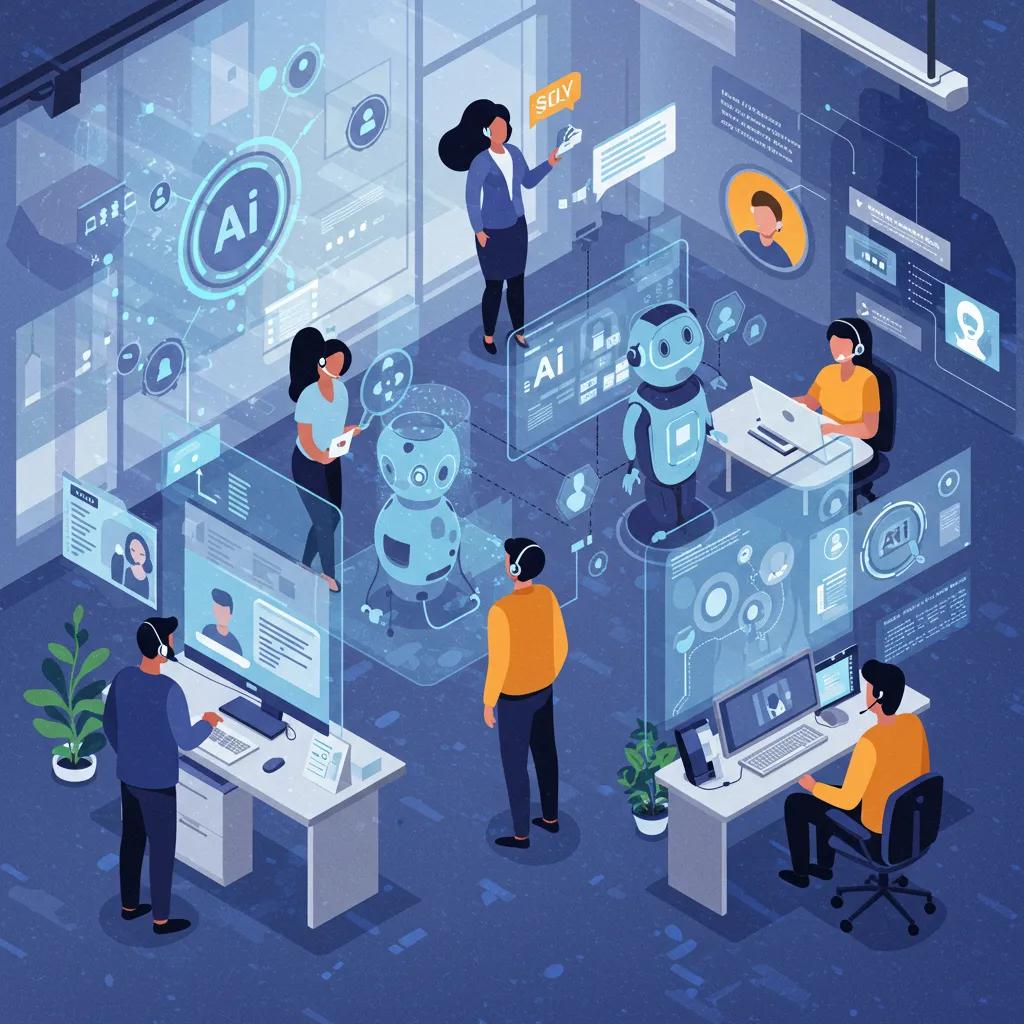
AI maintains consistency by carrying a shared conversation history and profile with the customer across channels so responses remain context-aware and escalations are seamless. Session persistence and centralized knowledge give AI copilots and agents the same canonical view of interactions, cutting repeated questions and speeding resolution. Orchestration layers control routing logic and prioritize channels based on preferences and real-time signals, improving satisfaction while lowering handling time. Building these features requires investment in pipelines, identity resolution, and governance to keep cross-channel coherence durable.
What new roles do voice AI and visual AI play in support?
Voice and visual AI are moving beyond basic IVR to deliver natural language understanding, sentiment analysis, and guided visual troubleshooting that speeds fixes. Voice AI listens to calls, understands what the caller wants, and directs them based on how urgent or emotional the situation is; visual AI finds product problems, shows how to fix them, and helps with claims by Early ROI includes lower mean time to resolution and higher digital self-service rates for image-supported workflows. Pilot these modalities on high-volume, high-value scenarios to measure impact and manage integration complexity.
How is human-AI collaboration redefining agent roles in 2025?
Human-AI collaboration shifts agents from ticket processors to problem solvers supported by AI copilots that summarize context, suggest replies, and automate routine tasks. Agent-facing AI boosts productivity by reducing time searching knowledge bases, auto-filling forms, and drafting responses while leaving judgment and empathy to people. This transition requires training, thoughtful interface design, and change management so agents trust and use copilots effectively. When treated as productivity multipliers, AI tools improve agent satisfaction, shorten onboarding, and raise customer outcomes.
Logical Content’s coverage of technology and AI trends offers practical examples showing how copilots change workflows; readers can explore our AI section and the article “Beyond Tasks: How AI is Transforming Project Management Tools for Smarter Workflows” for related case studies on agent augmentation.
What tools empower agents with AI copilots and assistive tech?
AI copilots help agents with real-time suggestions, automatic summaries, and contextual knowledge retrieval that lower cognitive load during conversations. Common features include auto-suggested reply templates, links to supporting docs, and one-click actions for routine tasks like refunds or account changes. Typical workflows show an agent reviewing a confidence-ranked suggestion, adjusting tone, and sending—cutting average handle time while preserving oversight. Vendors package these capabilities into agent desktops that integrate with CRM and telephony so assistance fits existing processes.
Why are training and upskilling essential for human-AI teams?
Training and upskilling teach agents to interpret AI suggestions, craft prompts for better outputs, and retain soft skills for complex, empathetic interactions. Effective programs blend AI literacy, scenario practice, and performance metrics that track accuracy, safety, and customer outcomes. Organizations should run continuous learning cycles informed by AI performance data to update curricula and certify proficiency. A people-first approach to change management preserves trust in AI and unlocks productivity from skilled, AI-augmented agents.
Which ethical AI practices build trust and protect data?
Ethical AI in customer service depends on transparency, consent, fairness, and strong data safeguards so customers know when AI is involved and can control their data. Best practices include explicit disclosure of AI use, bias testing for models affecting routing or prioritization, and strict access controls across training and inference pipelines. Data minimization and encryption paired with governance that records data lineage and model decisions reduce regulatory and reputational risk. Prioritizing explanation and consent improves adoption and aligns deployments with legal and customer expectations.
Use this short checklist to guide governance and customer-trust efforts—each item includes a brief rationale.
- Transparency and Disclosure: Tell customers when AI is involved so they can make informed choices.
- Consent and data minimization: limit data collection to what’s necessary and obtain clear permissions for personalization.
- Bias Testing and Fairness Audits: Regularly check models for disparate impacts to ensure fair treatment.
- Access Controls and Encryption: Secure training and inference data with strict controls to prevent exposure.
Applying this checklist builds trust and lowers the chance of downstream harms. The next section outlines concrete steps for transparency and fairness.
How can companies ensure transparency and fairness in AI customer service?
Foster transparency by labeling AI-driven interactions, offering concise explanations for automated decisions, and giving customers the option to speak with a human. Ensure fairness through dataset audits, representative sampling, and metrics that surface performance gaps across demographics or usage segments. Regular internal or third-party audits and an AI governance board help enforce accountability. Pair technical safeguards with policy and human oversight to balance innovation with customer rights.
What are best practices for protecting customer data in AI systems?
Protect data with encryption at rest and in transit, strict access controls for training datasets, and anonymization before training, if practical. Run vendor risk reviews to ensure third parties meet the same standards and define clear data-retention policies aligned with regulations. Continuous logging, monitoring, and periodic penetration testing validate controls over time, while role-based access limits who can view sensitive information. These measures reduce exposure and support privacy-compliant AI deployments.
How does AI-driven automation improve efficiency and operations?
AI-driven automation boosts efficiency by taking on repetitive tasks, streamlining workflows, and enabling autonomous agents to complete low-risk, end-to-end processes. Autonomous agents combine decision rules, API integrations, and verification steps to perform actions—status updates, refunds, or account changes—freeing humans for complex, empathetic work. Gains show up as reduced average handle time, higher automation rates, and lower cost per ticket when pilots are measured carefully. The table below compares automation types and typical KPI impacts to help operations plan.
| Automation Type | Typical Tasks | Typical KPI Impact |
|---|---|---|
| Autonomous Agents | Billing adjustments, status updates | Lower AHT and cost-per-resolution |
| Assisted Automation | Suggested replies and form fills | Higher agent productivity and improved FCR |
| Orchestration Workflows | Multi-step processes across systems | Faster end-to-end resolution and fewer handoffs |
| Analytics-driven Staffing | Forecasting and scheduling | Better occupancy and reduced shrinkage |
This comparison helps teams match automation types to operational goals and estimate KPI improvements for pilots.
What advantages do autonomous AI agents bring to end-to-end tasks?
Autonomous agents execute well-defined processes without human input, speeding resolution and reducing manual errors for routine tasks like refunds or status updates. They succeed when tasks have clear rules, dependable inputs, and rollback or verification steps for exceptions. Risk controls—confidence thresholds, human approval gates, and audit logs—keep operations safe while delivering measurable reductions in cycle time and cost. Start with low-risk scenarios, measure outcomes, and scale as reliability and governance mature.
How is AI improving contact center operations and lowering costs?
AI enhances operations with smarter forecasting, sentiment-aware routing, and automated QA that flags coaching and compliance issues faster than manual reviews. Predictive staffing helps create better work schedules to prevent having too few staff, and sentiment routing directs complicated or important customers to experts, leading to quicker solutions. Cost savings show up as lower AHTs, fewer repeat contacts, and higher agent utilization when AI automates the right tasks. Pilots should capture baseline KPIs and present clear ROI to secure wider investment.
We aim to provide practical, trustworthy analysis that keeps readers informed about global AI trends and helps teams take concrete next steps when evaluating AI for customer service.
Frequently Asked Questions
What challenges do organizations face when implementing AI for customer service?
Common hurdles include poor data quality, complex integrations, and employee resistance. AI needs accurate, representative training data; connecting new tools to legacy systems can be technically demanding; and staff may worry about job changes. Address them with phased rollouts, training programs, clear communication, and robust integration planning.
How can businesses measure the success of AI in customer service?
Measure impact with KPIs such as CSAT, first-contact resolution (FCR), average handle time (AHT), bot deflection, and fallback rates. Compare these metrics before and after AI deployments, supplement with qualitative customer feedback, and track long-term indicators like retention and cost-per-resolution to build a complete ROI picture.
What role does customer feedback play in improving AI support?
Customer feedback is essential for model refinement and experience design. It highlights misunderstanding, identifies missing intents, and surfaces tone or usability issues. Feeding feedback into continuous retraining and tuning cycles helps AI evolve toward more accurate, helpful responses and a better customer experience.
How can companies ensure ethical AI practices in customer service?
Adopt transparency, fairness testing, and strong data protections. Disclose AI use, obtain consent where required, run bias audits, and enforce strict access controls. Combine technical checks with governance—policy, audits, and accountability—to maintain trust and legal compliance.
What future trends should businesses watch in AI customer service?
Watch for deeper hyperpersonalization, finer-grained sentiment analysis, and expanded voice and visual AI capabilities. Expect more context-aware, multimodal experiences and growing use of autonomous agents for low-risk processes. Staying nimble and experimenting with focused pilots will help teams keep pace.
How can organizations balance automation with a need for human interaction?
Use a hybrid approach: let AI handle routine, high-volume tasks while reserving humans for complex, empathetic interactions. Define clear escalation paths, measure satisfaction, and iterate on automation thresholds so customers can switch to a human when needed and the overall experience improves.
Conclusion
AI-driven customer service will be a core driver of CX improvement in 2025. By combining generative and conversational AI, hyperpersonalization, and omnichannel integration—and by committing to ethical, privacy-first practices—organizations can speed resolution, boost satisfaction, and reduce costs. Use the trends and practical guidance here to design targeted pilots, measure outcomes, and scale responsibly as you modernize support.