
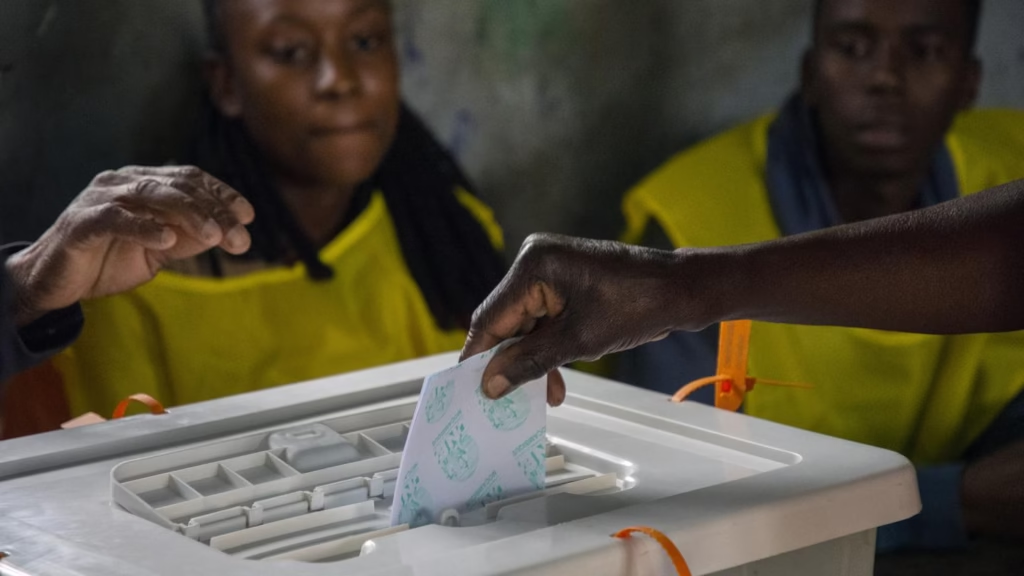
Imagine waking up on a Sunday morning, your coffee steaming on the counter, and your phone buzzing with a notification that a nation halfway across the globe has just voted in a leader who promises to completely rewrite the rules of international trade. Or picture a young voter in a bustling capital city, casting their first ballot in an election that could determine the fate of a decades-long peace process. This isn’t the plot of a political thriller; it’s the reality of 2025, a year that has already proven to be one of the most consequential for global democracy in a generation.
From the icy shores of Scandinavia to the sun-drenched plains of Africa, over 70 countries are holding national elections this year. The global economy, climate policy, and the very architecture of international alliances are being impacted by the staggering scale of this democratic exercise and its outcomes. In this post, we’ll dive deep into the most pivotal elections of 2025, unpack the seismic political shifts they’ve triggered, and explore what this all means for you, me, and the future of our interconnected world.
The Global Democratic Crossroads
2025 feels like a hinge in history. We’re witnessing a fascinating and often contradictory tug-of-war between two powerful forces: a resurgent wave of populism and a determined, if sometimes fragile, push for progressive, multilateral solutions to global crises. This tension is playing out on ballots from Berlin to Brasília.
On one side, economic anxieties fuelled by persistent inflation, the lingering effects of the pandemic, and fears over immigration have created fertile ground for leaders who promise simple, often nationalist, answers to complex problems. On the other, a growing awareness of existential threats like climate change and the urgent need for stable international cooperation is driving support for more centrist and collaborative governance.
This dynamic is not new, but its intensity in 2025 is unprecedented. According to the International Institute for Democracy and Electoral Assistance (International IDEA), this year’s elections will directly impact the lives of more than half the world’s population. The stakes couldn’t be higher. The votes cast in these booths will affect everything from the cost of food to the safety of your data and the air your kids breathe.
Spotlight on the Superpowers: The U.S. and India
No discussion of 2025’s political landscape is complete without focusing on its two largest democracies: the United States and India. Their elections are not just domestic affairs; they are global events with far-reaching consequences.
The American Reckoning
The U.S. presidential election, scheduled for November 5th, is already dominating headlines and social media feeds. The contest is shaping up to be a stark choice between continuity and a dramatic return to a more isolationist and confrontational foreign policy. Early polling by organisations like the Pew Research Centre suggests a deeply polarised electorate, with key swing states like Arizona, Georgia, and Pennsylvania once again holding the balance of power.
The outcome will have an immediate impact on global trade, with potential new tariffs or a recommitment to existing agreements. It will also determine America’s stance on critical issues like support for Ukraine and its approach to managing the complex relationship with China. For the average citizen, this election is about more than just foreign policy; it’s about the future of healthcare, reproductive rights, and the very norms of democratic discourse.
India’s Democratic Marathon
India, with its colossal electorate of nearly a billion voters, completed its marathon general election in June. The results were a testament to the resilience of its democracy but also a clear signal of the electorate’s priorities. Prime Minister Narendra Modi’s Bharatiya Janata Party (BJP) secured a third consecutive term, though with a reduced majority, forcing it to rely more heavily on its coalition partners.
This shift, while still a victory for the ruling party, indicates a growing demand for a more balanced approach to governance. Voters from key states expressed concerns about unemployment and the cost of living, signalling that economic performance is now just as crucial as cultural and national identity politics. For the world, a stable India is a critical partner in countering Chinese influence in the Indo-Pacific and a key player in global climate initiatives. The Election Commission of India managed this massive logistical feat with its usual efficiency, a reminder of the institutional strength underpinning the world’s largest democracy.
Europe’s Identity Crisis and the Rise of the Right
While the U.S. and India garner the most attention, Europe is experiencing a profound political transformation of its own. The year 2025 has seen a significant shift to the right across the continent, challenging the post-war liberal consensus that has defined the European Union for decades.
The far-right Alternative for Germany (AfD) party’s strong performance in state elections in Germany upended the political landscape. The result has put immense pressure on Chancellor Olaf Scholz’s fragile coalition, complicating Germany’s ability to lead EU fiscal and defence policies. Public frustration over migration and the economic burden of the green transition is largely responsible for the rise of the AfD.
Similarly, in France, President Emmanuel Macron is facing a formidable challenge from Marine Le Pen’s National Rally. The French election, expected later this year, is a critical test for the EU’s future. A victory for the National Rally could lead to a “Frexit” referendum, a scenario that would disrupt the global financial system and potentially unravel the European project. The European Parliament is closely monitoring these developments, as the health of its member states’ democracies directly influences its own power and relevance.
Not all countries are experiencing this rightward drift. In Portugal, a centre-right coalition recently won a decisive victory, promising a more fiscally conservative but still pro-EU agenda. A patchwork of national concerns is testing a shared identity in Europe in 2025, leading to fragmentation.
The Global South: A New Era of Assertiveness
Perhaps the most exciting and transformative political shifts of 2025 are happening in the Global South, where a new generation of leaders is charting an independent course on the world stage. These nations are no longer content to be mere spectators in a geopolitical game dominated by Washington and Beijing.
In Africa, a wave of democratic renewal has swept through several nations. Senegal’s peaceful and credible election in March powerfully rebuked a trend of democratic backsliding on the continent by seeing a young opposition leader defeat the incumbent’s chosen successor. This success story, supported by robust civic engagement, offers a hopeful blueprint for other nations. The African Union has played a crucial role in advancing these democratic norms, although its impact is still evolving.
Meanwhile, the political landscape in Latin America continues to fluctuate. After a period of left-wing dominance, countries like Argentina are now grappling with the economic realities of their policies, leading to a more pragmatic, market-friendly government under President Javier Milei. This shift is forcing a re-evaluation of regional alliances like Mercosur and its relationship with global powers.
This new assertiveness is most evident in the formation of new economic and political blocs. The BRICS+ alliance (Brazil, Russia, India, China, and South Africa, plus new members like Egypt and Ethiopia) is actively creating alternative financial institutions and trade mechanisms, challenging the dominance of the U.S. dollar and Western-led bodies like the International Monetary Fund. For citizens in these countries, the alliance means a potential for greater economic sovereignty and a louder voice in global affairs.
The Undercurrents: What’s Driving These Shifts?
Behind every ballot cast is a story of human concern and aspiration. To understand the global political shifts for 2025, we need to look at the powerful undercurrents that shape voter behaviour.
The Cost-of-Living Crunch
Inflation has been the silent voter in every election this year. From London to Lahore, families are struggling to afford basic necessities. This economic pain has eroded trust in traditional political parties and created an opening for outsiders who promise radical economic solutions, regardless of their feasibility. Central banks, such as the U.S. Federal Reserve, have been navigating a delicate balance between controlling inflation and preventing a recession, a manoeuvre that carries significant political consequences.
The Climate Imperative
Climate change has moved from a future threat to a present-day crisis. Devastating floods, wildfires, and heatwaves are now regular features of the news cycle, and voters are demanding action. Such demand has led to a surge in support for Green parties in Europe and has become a central plank in the platforms of progressive candidates worldwide. The success of the landmark Paris Agreement hinges on the political will of the leaders elected in 2025.
The Digital Disinformation Dilemma
We no longer only fight our elections at the polls but also in the digital arena. Foreign actors often support sophisticated disinformation campaigns that aim to sow discord, suppress turnout, and undermine faith in the democratic process itself. Social media platforms are under immense pressure to act as responsible gatekeepers, but the challenge is immense. In the lead-up to key elections this year, the Stanford Internet Observatory has documented a sharp increase in the use of AI-generated deepfakes to manipulate voters.
A Comparative Look: Key Elections of 2025
To make sense of this complex global picture, let’s break down some of the most critical elections and their potential global impact.
| Country | Election Date | Key Contenders | Primary Issues | Potential Global Impact |
|---|---|---|---|---|
| United States | November 5, 2025 | Incumbent vs. Challenger | Economy, Abortion, Foreign Policy | Direction of NATO, U.S.-China relations, Global climate leadership |
| France | Expected June 2025 | Emmanuel Macron vs. Marine Le Pen | Immigration, EU Future, Economy | Stability of the EU, the future of the Euro, European defense policy |
| Canada | Expected October 2025 | Justin Trudeau vs. Pierre Poilievre | Housing Crisis, Healthcare, U.S. Relations | North American trade (USMCA), Arctic policy, Climate commitments |
| South Africa | May 29, 2025 | ANC vs. DA vs. MK Party | Unemployment, Corruption, Power Crisis | Stability of a key African economy, BRICS+ influence, Investment climate |
| Iran | June 2025 (Presidential) | Hardliners vs. Moderates | Nuclear Deal, Economy, Social Freedoms | Tensions in the Middle East, Global oil markets, Nuclear non-proliferation |
A common thread emerges from this table: a nation’s global posture now inextricably links domestic economic concerns. A leader’s ability to manage their economy directly influences their credibility and power on the world stage.
Expert Insights: Navigating the New Normal
To get a more profound understanding, I spoke with Dr Anya Sharma, a senior fellow at the Council on Foreign Relations. “What we’re seeing in 2025 is the end of the post-Cold War unipolar moment,” she explained over a video call from her office in New York. “We are now in a truly multipolar world. The elections this year are not just about who wins a single country but about which vision for this new world order will prevail: one based on rules and cooperation or one based on power and spheres of influence.”
She emphasised that the key for ordinary citizens is to become more globally literate. “Your local representative’s stance on a trade deal with Asia or a climate accord in Europe will eventually affect your job and your community. The world is too connected for us to think in purely national terms anymore.”
Grassroots activists around the world echo this sentiment. In Nairobi, community organiser Kipchoge Mwangi told me, “Our election wasn’t just about choosing a president. It was about choosing between being a nation that builds its own future or one that reacts to others’ agendas. That’s a choice every democracy is facing right now.”
Your Action Plan: Staying Informed and Engaged
In a world of information overload, it’s easy to feel overwhelmed or cynical. But informed and engaged citizens are the bedrock of a healthy democracy. Here’s how you can stay on top of these global shifts without losing your mind.
- Diversify Your News Diet: Don’t rely on a single source or platform. Seek international perspectives from reputable outlets like the BBC, Al Jazeera, and The Economist. These tips will help you see past your country’s media bias.
- Follow the Data: Organisations like the World Bank and the United Nations provide invaluable, non-partisan data on global trends in economics, health, and development. Understanding the facts is the first step to forming an informed opinion.
- Engage Locally, Think Globally: Your city council or local representative is often involved in international sister-city programmes or trade delegations. Attend their meetings and ask how global events are impacting your community. Your voice matters at every level.
- Support Media Literacy: Share resources on how to spot disinformation with your friends and family. A well-informed public is the best defence against manipulation.
Conclusion: The Future is Being Written at the Polls
As we progress through the remainder of 2025, the world will continue to grapple with each new election outcome. The political shifts we are witnessing are not just a series of isolated events; they are chapters in a much larger story about the future of our global community. Will we choose a path of division and competition or one of collaboration and shared prosperity?
The answer lies not just with the leaders we elect, but with us—the citizens. Our curiosity, our critical thinking, and our willingness to engage in the democratic process, both at home and in our understanding of the world, are the most powerful tools we have. The elections of 2025 serve as a painful reminder that democracy is not a static monument but a dynamic practice that necessitates constant care and participation.
Frequently Asked Questions (FAQ)
Q: Why should I care about elections in other countries?
In our globalised world, a political decision in one country can have a direct impact on your life. A trade policy change in the U.S. can affect the price of imported goods. A climate policy shift in China affects global emissions. A conflict sparked by political instability in one region can disrupt global supply chains and energy prices. We are all connected.
Q: Is the rise of populism a global trend or just a temporary blip?
While the intensity varies by region, the underlying drivers of populism—economic inequality, cultural anxiety, and distrust in traditional institutions—are global phenomena. Whether it’s a long-term trend depends on whether mainstream parties can effectively address these root causes with credible solutions.
Q: How can I tell if an election is free and fair?
Look for key indicators such as independent election monitoring by organisations like The Carter Centre, equal access to media for all candidates, fair campaign finance rules, and a transparent vote-counting process. A vibrant, independent press is also a crucial watchdog.
Q: What is the biggest threat to democracy in 2025?
Experts point to a combination of factors: the erosion of trust in institutions, the weaponization of social media for disinformation, and the increasing polarisation that makes compromising seem like a betrayal. The greatest threat is often complacency from citizens who take their democratic rights for granted.
Q: Can a single vote in my country really make a difference on the global stage?
Absolutely. Your vote helps elect leaders who will make decisions on foreign policy, trade, and international cooperation. A collective shift in the electorate of a major nation can alter the course of global events. Democracy is a team sport, and every player counts.